Honduras will hold general elections in November
The polls are still inconclusive, although the three who have the best chances to conquer the presidency are: Moncada, Nasralla, and Asfura.
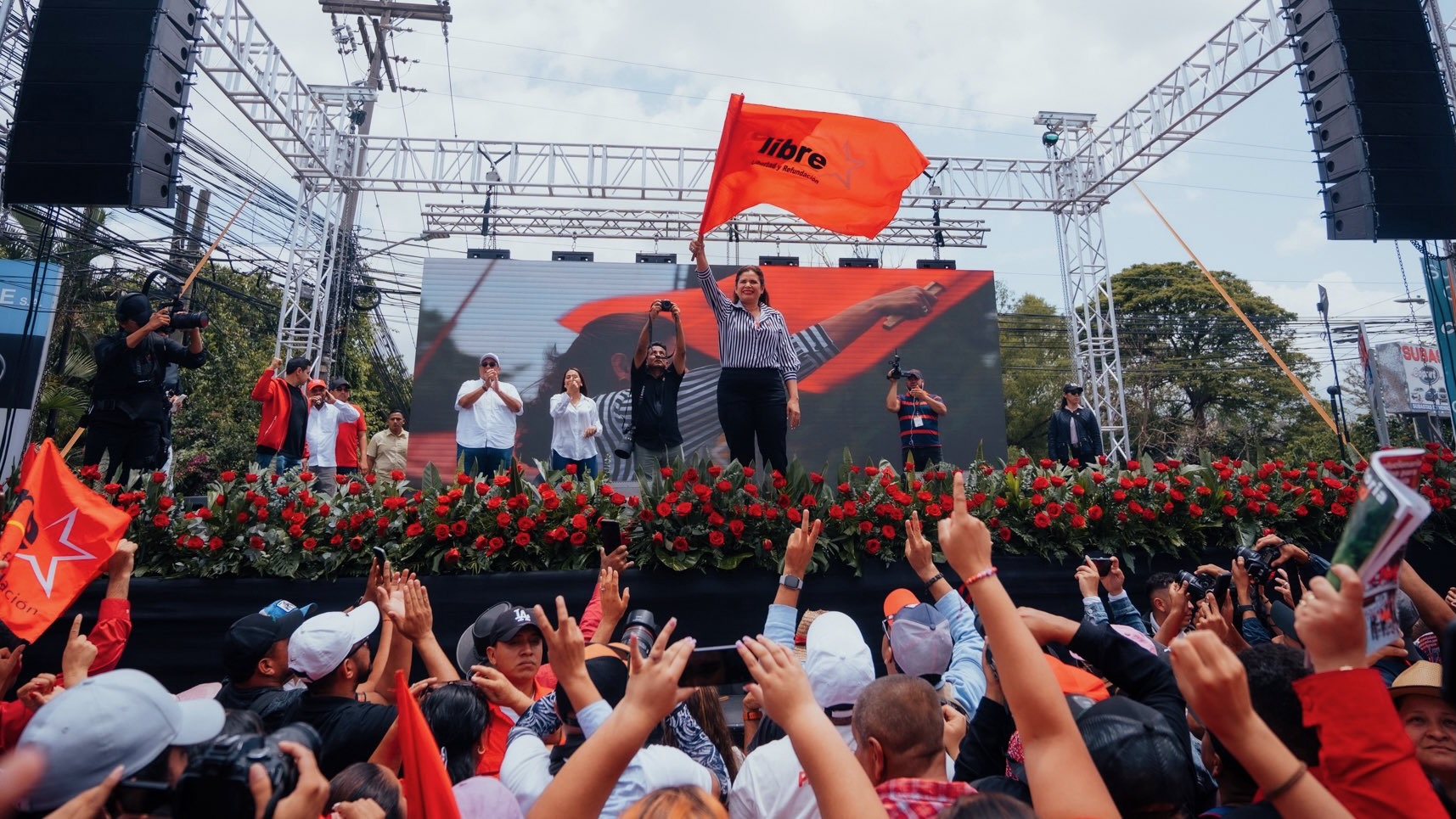
LIBRE candidate Rixi Moncada at a June 28 rally in Honduras ahead of the party primaries. Photo: X
The Honduran people will go to the polls on November 30 to elect their next president. They will also elect 128 deputies to Congress, 20 deputies to Parliament, 198 mayors, and more than 2,000 councilmembers.
For almost the entire 20th century, the two-party system had dominated the Honduran electoral scene, with the Liberal Party of Honduras (PLH), founded in 1891, and the National Party of Honduras (PNH), created in 1903, as the two major political leaders of a country ravaged by poverty and inequality.
Within Honduran Liberalism, there have been tensions between more progressive and revolutionary positions and those that are more centrist and center-right. From its ranks emerged the progressive Juan Manuel Zelaya, who governed Honduras between 2006 and 2009. His mandate was interrupted by a coup orchestrated by the right-wing and supported by the United States.
Read more: “Conservative elements wanted to stop the process of change underway in Honduras”
After suspicions arose of the coup being the result of an inter-party plot, Zelaya and his followers decided to create the Liberty and Refoundation Party (LIBRE) in 2009, which managed to break with the century-old Honduran bipartisanship when it reached the presidency under the hand of Xiomara Castro (2022-until today), Zelaya’s wife. Castro’s victory ended 12 years of rule by the far-right National Party which many characterized as a “narco-dictatorship”.
Castro’s government has been characterized by the widening of the state, especially in public social policies, and for having been an ally of the leftist and progressive governments of Latin America.
In recent weeks, Castro has sought to expel all members of her party who are allegedly involved in acts of corruption, the cases of the vice president of Parliament, Isis Cuellar, and the secretary of Social Development, Jose Carlos Cardona, being very well known. Both have been removed from their positions and the LIBRE party.
Primary elections
The primary elections were held, with some inconveniences, on March 9, 2025. The three most important parties in the country (PLH, PNH, and LIBRE) held primaries, all of which seek to gain control of the Executive and Legislative branches, as well as the intertwined network of local power that runs through Honduran institutions.
Liberal Party of Honduras (PLH)
The candidates of the Liberal Party were Maribel Espinoza, Salvador Nasralla, Luis Orlando Zelaya, and Jorge Luis Cálix. Even though all of them have a solid political career, Nasralla emerged victorious with 58.08% of the votes, while Cálix reached 31.67%.
Nasralla has already sought the presidency twice: in 2013 for the Anti-Corruption Party and in 2017 in an alliance with the party he now seeks to defeat, LIBRE. This television presenter and civil engineer even formed part of Castro’s government as vice-president between 2022 and 2024. In this sense, Liberalism will bet on a figure close, although independent, to the progressive and leftist ideals that Castro’s government has shown.
National Party of Honduras (PNH)
On the other hand, in the National Party, of right-wing and conservative tinge, four presidential pre-candidates participated in the primaries: José Alberto Zelaya, Ana Rosalinda García, Nasry Juan Asfura, and Roberto Martínez Lozano. In this case, the result was also clear and convincing: Asfura obtained 75.84% of the votes, far ahead of García, wife of convicted former president Juan Orlando Hernández (accused of drug trafficking), who only obtained 21.31%.
Asfura, son of Palestinian migrants, also known as “Papi a la Orden”, is a businessman with a well-known political career. He lost the presidential election to Castro in 2021. He was director of the Honduran Social Investment Fund in the government of Porfirio Lobo, a congressman between 2010 and 2014, and mayor of the country’s capital, Tegucigalpa (2014-2022), a position that has given him significant visibility and ability to control the PNH.
Liberty and Refoundation Party (LIBRE)
In LIBRE, the decision of its bases was also overwhelming, as they chose between two candidates. Rixi Moncada achieved an incredible 92.64% of the vote against Rasel Tomé (vice-president of the parliament), who did not exceed 8%. Moncada, one of the party’s most senior figures, was secretary of labor in the Zelaya government and its representative before the dialogues that sought to resolve the crisis.
In Castro’s government, she assumed the secretariat of finance, which she resigned from in 2024 to dedicate herself to the electoral campaign. However, she momentarily decided to abandon the campaign to assume the secretariat of defense after a slight crisis in the cabinet. She resigned in 2025 to participate in the primaries.
Other parties that will participate in the presidential elections are the Innovation and Social Democratic Unity Party, with economist Jorge Nelson Ávila at the head, and the Christian Democratic Party, which will seek the presidency with publicist Mario Rivera.
Inconclusive polls
As of now, it is very difficult to say who is ahead in the polls, as they differ greatly. A July poll by TVS television station reported that Moncada has 40% of the vote intention. In second place would be Nasralla with 31.54%, and Asfura with 27.41% of the votes.
This is the same trend shown by the pollster TResearch in March. According to this, the LIBRE candidate would have 44.6% of the voting intention, ahead of Nasralla (28.1%) and Asfura (22.3%).
Very different is the version of Pro Encuestas, according to which Asfura would lead the voting intention with 36.34%. In second place would be Nasralla with 34.22%, and in third, Moncada, with 28.48%.
For the time being, the elections will be contested among the three well-known candidates. However, not all the cards are yet on the table in a country that seems to be crossed by very old powers that could use all kinds of mechanisms to tilt the political balance in their favor. The elections are still several months away, and the candidates know it. That is why the electoral campaign will be more a test of strategic endurance than of speed.