Rights groups say the ban of YouTube channels in Pakistan is an attack on press freedom
The current government in Pakistan has been accused of cracking down on all forms of dissent and political opposition in the country by misusing state institutions.
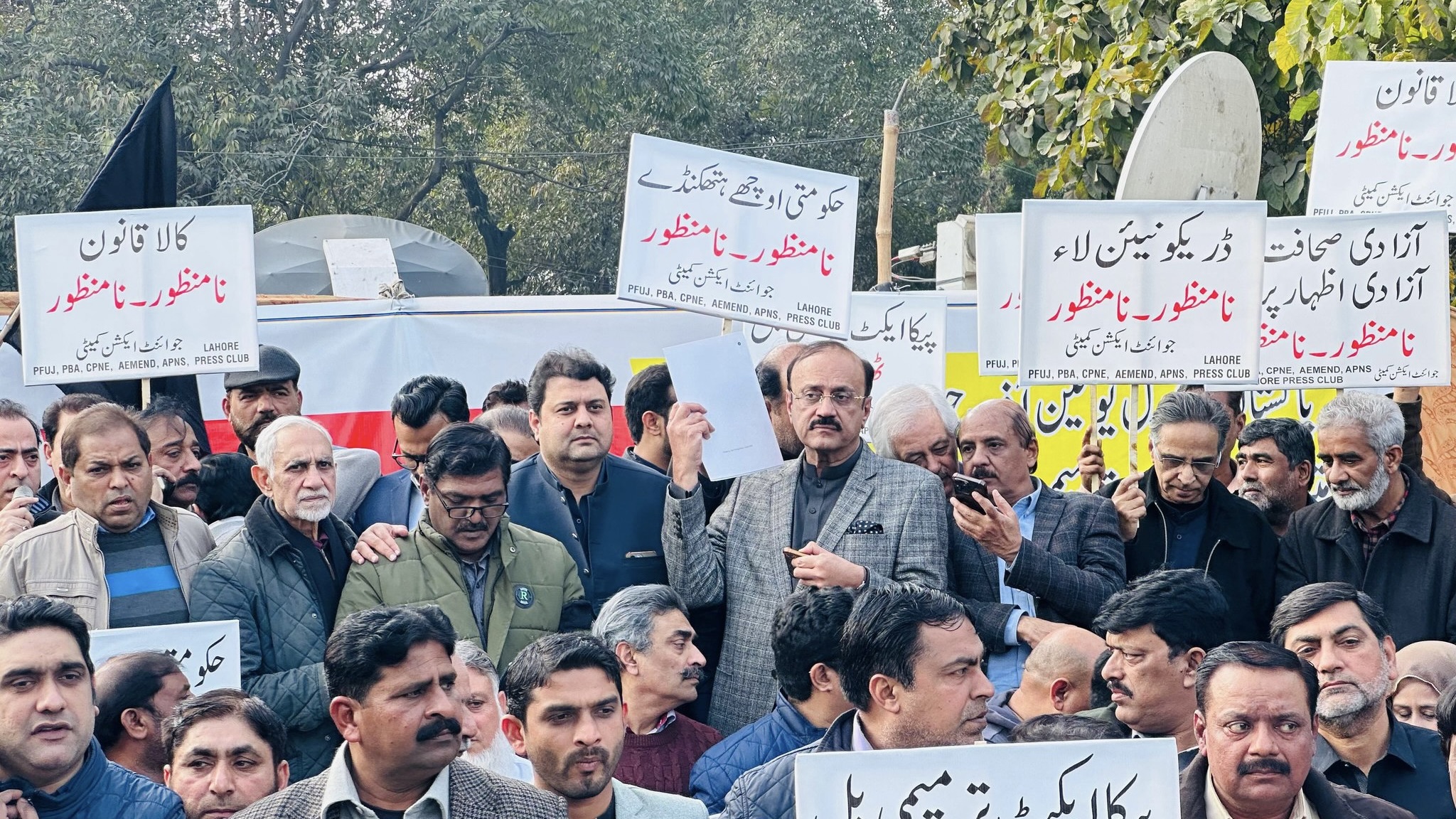
Protest outside the Lahore Press Club and Punjab Assembly against the PECA Act Amendment Bill. Photo: Farrukh Javed Moon/X
Right groups call a Pakistan court’s order to shut down over two dozen YouTube channels belonging to opposition parties, critical independent journalists, and others an assault on press freedom and critical voices and demand its immediate withdrawal.
Most of the channels on the ban list belong to the main opposition party Pakistan Tehreek-e-Insaf (PTI), its founder and former prime minister Imran Khan is currently in jail. Some channels belong to independent journalists such as Asad Toor and Matiullah Jan, who have been critical of the current ruling administration and have suffered assaults in the past – suspected to be backed by the state.
The order to ban the channels was issued by a local court in Islamabad on June 24. However, it was only made public earlier this week. Alphabet, the parent company of Google which owns YouTube, has already issued warnings to the channels to comply with the court order or face the ban.
The order was a result of a report filed by the National Cyber Crime Investigation Agency on June 2. The report accused the channels of “sharing highly intimidating, provocative and derogatory contents against state institutions and officials of the state of Pakistan,” Reuters reported.
Reuters reported Pakistan’s interior minister accusing the channels of trying to spread “chaos” in the country, calling their content provocative and false.
The news of the ban on channels has incited strong reactions from opposition groups and human right organizations in Pakistan, who accused that the Shehbaz Sharif government is attempting to crack down on all forms of dissent in the country.
The Sharif government, since coming to power, has faced accusations of using the state machinery to silence criticism of its policies and block the operations of opposition parties, particularly the PTI.
The government has banned various social media platforms and the internet several times since coming to power. On several occasions the ban coincided with mass mobilizations against the government.
In January, the Pakistan government enacted controversial amendments in the country regulating digital media. The law, called Prevention of Electronics Crimes Amendment Act (PECA), not only introduced harsher punishments for spreading “fake news” but also increased government oversight of the digital platforms.
The amendments sparked huge protests of journalists, activists, and political opposition who claimed the act gives unprecedented power to the government to define “fake news” and silence the voices of dissent by threatening harsher punishments.
Attack on press freedom and dissent
PTI called the ban of YouTube channels an attempt by the government to suppress the facts about the failures of their policies and their human rights violations across the country.
The opposition party claimed that YouTube channels have emerged as an alternative to the mainstream media which is fully controlled by the establishment and mostly fails to report on the real issues the people of the country are facing.
PTI spokesperson Zulfikar Bukhari told Reuters that such attempts by the government to control the digital media space as it controls the mainstream media, however, are bound to fail as it is impossible to do so in the current digital landscape.
The Human Rights Commission of Pakistan (HRCP) also condemned the government’s move to ban the YouTube channels. It claimed that “the wholesale blocking of entire channels-rather than addressing specific instances of unlawful or hateful speech in accordance with due process-conflates dissent with criminal activity.”
“The constitutional right to freedom of speech is fundamental not only for individual liberty but also for ensuring government accountability, fostering debate and enabling the public to access a diversity of viewpoints,” HRCP said in the statement.
Several other groups in Pakistan also condemned the move, questioning the lack of due process and calling it an attack on press freedom. They demanded the immediate withdrawal of the order.
“This act of censorship, under the allegations of false and misleading content, is a dangerous escalation in the ongoing assault on press freedom and the right of dissent in the country,” claimed the Forum for Digital Rights and Democracy (FDRD).
FDRD also appealed to civil society, media houses, and international human rights groups to push back against “these undemocratic practices” in Pakistan to stop the drift towards the complete obliteration of all kinds of dissent in the country.