US Republicans brace for voter rebellion over “Big Beautiful Bill”
Republican Party leadership has urged lawmakers to move quickly to promote the bill in order to ensure support of the population
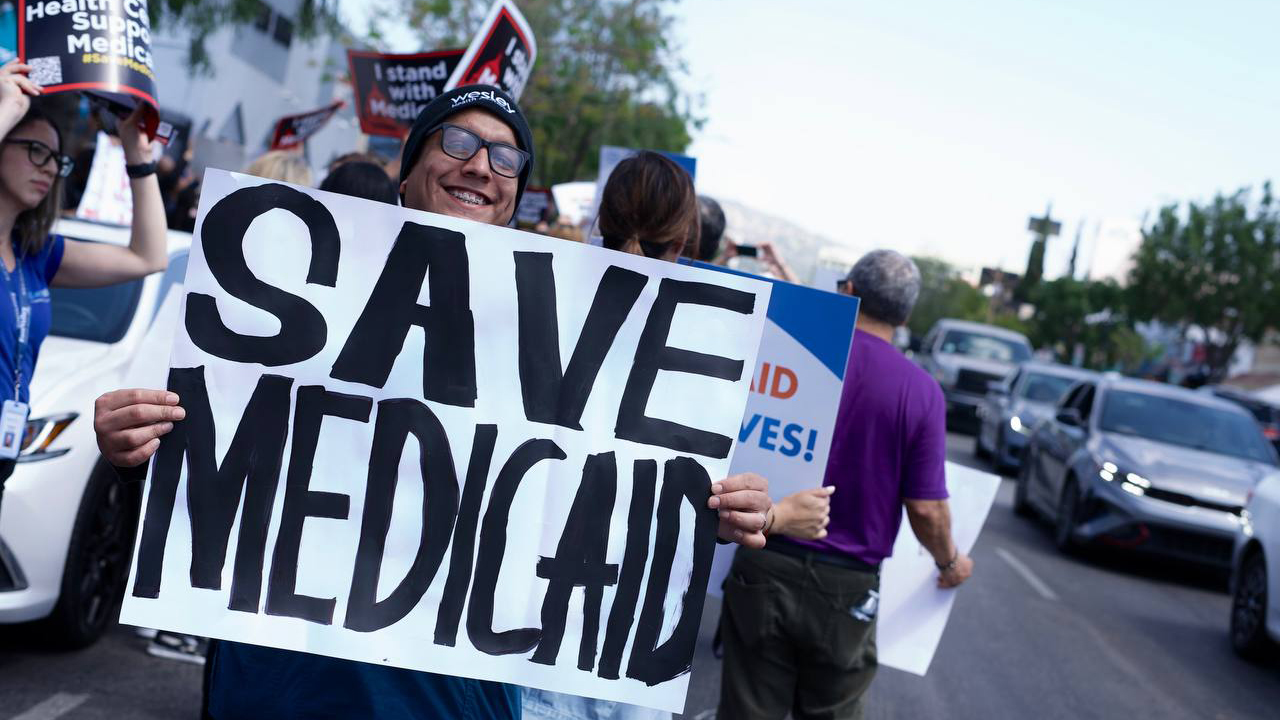
Protesters rally to defend Medicaid in Los Angeles (Photo: Colin Ortiz)
Despite creating waves of disagreement and rifts within Donald Trump’s coalition, the passage of the “One Big Beautiful Bill” appears to have gone as planned. Marking US Independence Day on July 4, Donald Trump signed the bill into law after it successfully passed both the House and the Senate. The Trump administration seems to have done in seven months what Biden attempted unsuccessfully throughout his entire presidency in the form of “Build Back Better”: sign a massive federal spending proposal into law.
But while the Trump administration does its victory lap, Republican Party leadership is planning for a potential backlash to the new law, which remains largely unpopular due to proposed cuts to SNAP and Medicaid, as well as the injection of billions of dollars towards expanding ICE detention and immigration enforcement arrests.
Axios reports that the National Republican Senatorial Committee is planning to send a memo to chiefs of staff in the Senate Republican Party, ordering Senators and staff to “immediately get to work promoting its most popular provisions in every corner of their states.”
“With the passage and signing of OBBB, Senate Republicans have delivered on the America First promises President Trump campaigned on. Now, senators and staff need to do their part to ensure every voter knows it,” the memo reportedly states. “Communicating the widely popular provisions within the OBBB effectively will be essential to turning out the coalition Republicans need to win in next year’s midterm election.”
With Medicaid on the chopping block, lawmakers fear backlash
Some Republican lawmakers have openly panicked about the effects of the bill on their popularity among constituents. North Carolina Senator Thom Tillis denounced the bill in an impassioned speech on June 29.
“What do I tell 663,000 people in two years or three years, when President Trump breaks his promise by pushing them off of Medicaid because the funding’s not there any more, guys?” Tillis asked fellow Republicans on the Senate floor.
The “663,000 people” Tillis was referring to are the North Carolinians who gained health care coverage through the state’s Medicaid expansion program. Medicaid expansion in North Carolina is set to end with the implementation of the Big Beautiful Bill, as the bill’s proposed Medicaid Provider Tax Cap and work requirements could severely cut federal funding. When North Carolina’s conservative-dominated legislature passed Medicaid expansion, they included a so-called “trigger law” that would end the program if the federal government is not covering 90% of the cost. North Carolina is only one of several states with such “trigger laws”. The amount of people who could lose Medicaid coverage due to these laws throughout the country could be as high as nearly 3.7 million.
GOP town halls turn tense
As early as March, Republican Party leadership was advising GOP lawmakers to avoid in-person town hall meetings with constituents after confrontations with angry voters went viral. But the backlash only escalated as lawmakers fell in line behind the “Big Beautiful Bill.” In late May, callous remarks by Republican Iowa Senator Joni Ersnt drew widespread criticism after she was confronted at a town hall meeting. When a constituent shouted that people would die without public healthcare, Ernst responded, “Well, we’re all going to die,” prompting an outcry from the crowd. In a response video following the controversy, Ernst doubled down, filming a sarcastic apology while walking through a cemetery that was visible in the background.
Nebraska Representative Mike Flood experienced similar backlash after a town hall in late May 27, during which he admitted he hadn’t read the full “Big Beautiful Bill,” drawing backlash over a provision limiting judicial enforcement. He was also criticized for Medicaid cuts and responded, “Do you want illegal immigrants to get tax-funded benefits?” The crowd shouted back: “yes”.
Republican Representative Mike Lawler was also booed at a town hall in Rockland County, in the state of New York. Lawler argued to an angry crowd that the claims of proposed Medicaid cuts are exaggerated. “When it comes to Social Security and Medicaid, there have been no cuts,” Lawler claimed. “Nobody has received less benefits. There’s not a single person in this room that is on Social Security or Medicare that can honestly stand here and say that they have received a cut.” The crowd jeered in response.
Democratic voters want leaders to push harder
Democratic Party officials have begun using the potential coming wave of backlash to the bill as their strategy for winning the 2026 midterm elections. Since the embarrassing loss of the Party’s candidate for President in 2024, which closely followed the visibly mental decline of then-President Biden, the Party’s image has taken an enormous hit.
However, criticisms abound regarding the establishment leadership of the Democratic Party not going far enough to fight the bill. One poll from June showed that nearly half of those surveyed in the US had not even heard of the bill, and only 8% had heard about the potential Medicaid cuts, highlighting the weaknesses in the opposition’s communication strategy. Pew Research Center polling from April revealed that most Democratic voters do not believe their party was fighting hard enough against Trump’s policies.