US delists Syria’s HTS as Foreign Terrorist Organization
The move is seen as an incentive by the Trump administration for Syria's interim government to sign a normalization agreement with Israel.
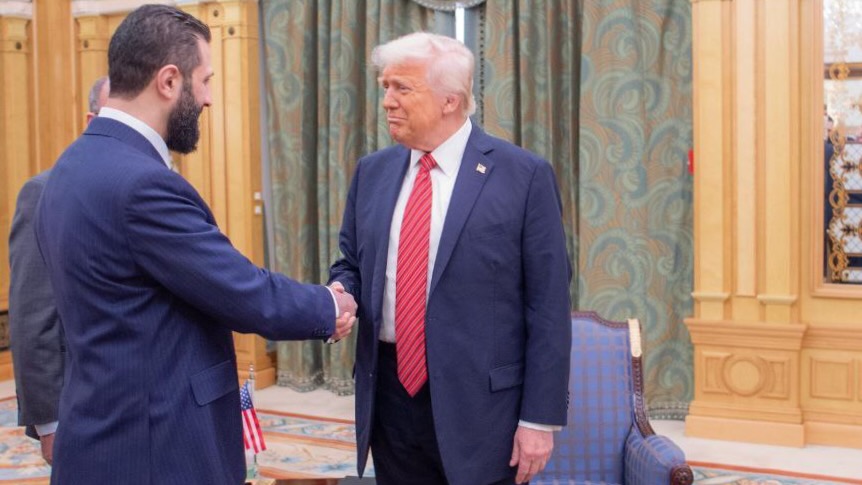
A meeting between Syrian President Ahmad al-Shara, US President Donald Trump, and Saudi Crown Prince Mohammed bin Salman in Riyadh on May 14. Photo: Al-Sharaa/X
US Secretary of State Marco Rubio announced in a press statement on Monday, July 7, the revocation of the designation of Foreign Terrorist Organization (FTO) for Hay’at Tahrir al-Sham (HTS), previously known as Al-Nusra Front, effective Tuesday, July 8.
Rubio clarified that the decision was made in line with US President Donald Trump’s promise to lift sanctions on Syria in May. It also followed the dissolution of the organization in January, and the commitment of the new government, whose officials are mainly former leaders or members affiliated with HTS, to “combat terrorism in all its forms”.
The US official highlighted the significance of the step in fulfilling Trump’s vision of “a stable, unified, and peaceful Syria.” However, recent regional developments foreshadow a potential role the Ahmad al-Shara’a administration is playing in shaping the geopolitical future of West Asia, as the US pushes for normalization between Syria and Israel.
Reports reveal a gradual process towards normalization
Media reports in the last couple of weeks suggest that US-brokered “preliminary discussions” have been held with Syria and Israel for a possible security deal.
According to Axios, these talks may have not touched on the normalization of ties between the two countries, but they could pave the way for future diplomacy that may lead to that end.
Axios suggests that reducing tension along the common borders, and updating security arrangements are necessary efforts to be made as a starting point.
In late June, Israeli media quoted Israel’s National Security Adviser Tzachi Hanegbi, confirming that Syrian and Israeli officials were engaged in direct daily talks on the possibility of normalization. However, Syria’s state-run media outlets rejected statements on any normalization deals as “premature”.
On Friday, July 4, Israeli reports claimed that Syrian President Ahmad al-Shara’a made demands in exchange for peace with Israel. These demands include the return of one third of the occupied Golan Heights, and reclaiming sovereignty over areas in Lebanon, which were detached from Syria to form the Lebanese state during the French Mandate, including the city of Tripoli.
Sealing a trilateral regional water-sharing agreement involving Türkiye, Syria, and Israel, is said to be another demand of al-Shara’a’s. Such a deal would permit Israel to construct a pipeline to transport water from the Euphrates River to the territories under its occupation.
Analysts argue that al-Shara’a is making such demands in an attempt to gain support from the Syrian public, amid concerns that he would face strong internal opposition for moving towards normalization with Israel.
Read more: Terrorist attack on church kills 27 worshipers in Damascus, Syria
Syria to cooperate with US to reinstate 1974 disengagement deal with Israel
Although no official Syrian source has confirmed the news about al-Shara’a’s demands for the agreement, Syrian Foreign Minister Asaad al-Shaibani said in a statement on Friday that his country is ready to cooperate with the United States to reinstate the 1974 disengagement agreement with Israel.
The agreement was reached one year after the 1973 Arab-Israeli war, establishing an 80 km buffer zone controlled by the United Nations Disengagement Observer Force (UNDOF) to separate the Syrian forces from the Israeli Occupation Forces (IOF).
Two days after the fall of Syria’s former president Bashar al-Assad last December, the IOF violated Syria’s sovereignty by advancing almost 25 kilometers into southern Syria, 10 kilometers beyond the demilitarized buffer zone.
In February, Israeli Prime Minister Benjamin Netanyahu declared that the IOF will continue occupying the summit of Mount Hermon (known as Jabal al-Sheikh) in the occupied Golan Heights “indefinitely”.
Netanyahu claimed that the IOF’s de facto occupation of the Syrian territories aimed to protect the adjacent “buffer zone” from the HTS and the new Syrian army in the process of being formed.
Normalization with Syria as part of the “New Middle East” plans
The West Asia region has seen major developments over the past couple of years, increasing the US-Israeli determination to eliminate the Axis of Resistance, and convince more countries in the region to normalize ties with Israel.
Netanyahu has been boasting about his alleged victory in Iran after Israel’s unprovoked attack on the country last month, while the US is pushing for the disarmament of Hezbollah in Lebanon that may pave the way for a potential normalization deal between Israel and the Lebanese state.
“I think we can work out a peace between us and the entire Middle East with President Trump’s leadership, and by working together, I think we can establish a very, very broad peace that will include all our neighbors,” Netanyahu said during a dinner in the White House Blue Room on Monday.
Backed by the US, Israel has waged a devastating two-year war on the region, during which its forces have killed tens of thousands of people, and have expanded into the territories of other sovereign states.
Yet, the US and Israel have been promoting an alleged peace plan under the name the “New Middle East”, where Israel would have unrestricted hegemony that would enable the “Greater Israel” project to become a reality. Achieving this level of expansionism, however, may not be possible without crushing the Axis of Resistance.