“Every man for himself”: Texas reels after flash floods and 90+ death toll as Trump plans to slash federal disaster response
The devastation of Kerr County, Texas from flash floods highlights gaps in local, statewide, and federal disaster response
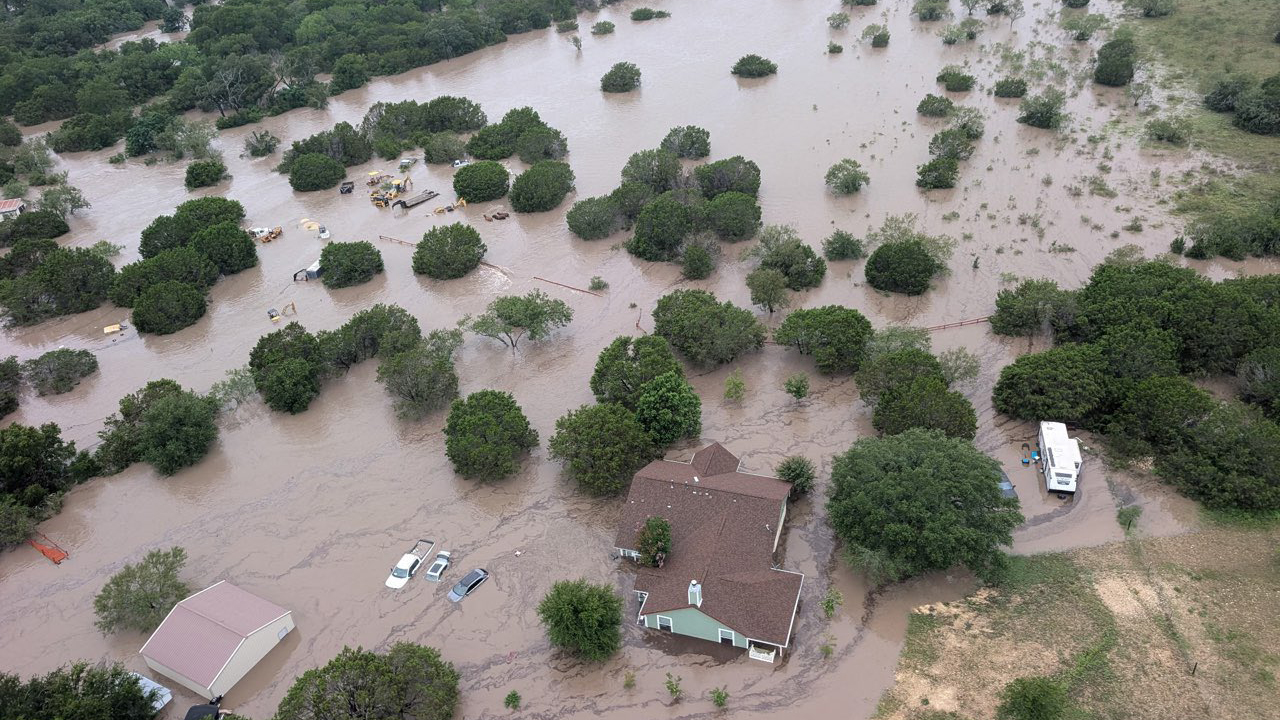
Flooding of the Guadalupe River, near Kerrville, Texas (Photo via Wikimedia Commons)
With over 100 confirmed fatalities, including 28 children, from a massive flash flood in central Texas, the state is reeling from one of the deadliest flooding disasters in the last century.
Up to 12 inches of rain fell in South Central Texas early on July 4, with flooding lasting for three days. The floods wreaked havoc in the area, hitting Kerr County the hardest. A Christian girl’s summer camp in Kerr County, Camp Mystic, reported 27 deaths of both children and staff. At the time of this writing, over 41 people across central Texas are still missing, according to authorities. At least 850 people have been rescued or evacuated.
Texas is no stranger to devastating disasters. In 2021, Texas suffered a winter storm and subsequent a power crisis that resulted in over 4.5 million homes and businesses losing power – resulting in shortages of water, food, and heat. A Buzzfeed News analysis estimated that the power crisis caused a far larger death toll than the state had tallied, estimating 702 total deaths from the infrastructure failure following the storm.
Kerr County scrapped flash flood warning system
“The reality is that information just did not get disseminated in a way that communicated any sort of urgency to the people on the ground,” said Brianna Griffith, a community organizer based in Texas, who is coordinating a community-based response network to fill in gaps in the state and federal government response.
In 2016, a Kerr County commissioner said in a meeting that the county was “probably the highest risk area in the State for flooding” and that the county’s flood warning system was “pretty antiquated” and “marginal at the best.” Nonetheless, in 2017, Kerr County opted to not install a comprehensive flood-warning system which would have warned residents of sudden dangerous flooding. The County could not secure approximately USD 1 million in funding. “Taxpayers won’t pay for it,” said Kerr County judge Rob Kelly in a New York Times interview.
According to Griffith, who also organized a community response to the 2021 power outages, a lack of adequate disaster response is “very acute in Texas.”
“Every time there’s a disaster of some sort or another, the immediate response of the government is to usually issue some sort of evacuation orders. And then after that, during the catastrophe, it’s every man for himself,” Griffith told Peoples Dispatch. “It becomes kind of a free for all scramble, where there’s no sense that the government has any sort of obligation to actually protect its people, beyond telling people to get out of the way of the disaster.”
Trump promises to phase out FEMA
This disaster is also occurring amid Trump’s plans to begin “phasing out” the Federal Emergency Management Agency (FEMA) entirely, after this year’s hurricane season. “We’re going to give out less money,” Trump said during a White House briefing. The president has mentioned shifting the burden of disaster response from the federal government to the states.
“As someone working in disaster response, I can’t help but grieve deeply over what’s happening in Texas—and what it signals about where this country is heading,” said a current FEMA employee who spoke to Peoples Dispatch. According to this employee, who will remain anonymous due risks of potential retaliation from the Trump administration, the flash floods in Texas “were a preventable tragedy made worse by years of ignored warnings, disinvestment, and policy choices that put profit over people.”
“Essential safety agencies like the National Weather Service, NOAA, and FEMA are being gutted. At least eight National Weather Service offices no longer staff overnight teams. That’s why no one could sound the alarm in Kerr County the night the flood hit. Because the resources weren’t there.”
“Local governments, especially rural and poor ones rely heavily on FEMA’s guidance. But if FEMA is dismantled, no one steps in. Communities will be left in mold, soot, and rubble. Many are never able to recover as many are still recovering from past storms like Hurricane Katrina or Maria. Most local governments are unequipped to handle large-scale disasters alone.”
FEMA funding was already in jeopardy during Biden’s administration, when the disaster relief agency ran out of funds before the peak of hurricane season in 2024. This was despite the fact that members of Congress left Washington two days earlier than planned, precisely because of Hurricane Helene– including conservative lawmakers from Florida Senator Rick Scott and Representative Matt Gaetz, who both opposed FEMA funding or skipped the vote to be in Florida ahead of the hurricane. That year, the US South was devastated by the effects of Hurricanes Helene and Milton.
According to Tina Landis, who works in environmental protection and is the author of “Climate Solutions Beyond Capitalism”, the flash flooding in Texas also points to the increasing dangers of extreme weather events due to human-made climate change. “Rising greenhouse gases means rising temperatures and more water vapor in the atmosphere, which results in heavier rains often coming as atmospheric rivers, as well as other extreme weather events,” Landis told Peoples Dispatch. “The Trump administration’s cuts to environmental protections and climate research will accelerate climate change and make us all more vulnerable to extreme weather events due to lack of accurate data to track and predict storms,” Landis warned.