In the face of new geopolitical challenges, CELAC proposes greater unity
After several months of preparation and three days of intense meetings at the highest diplomatic level, the IX Summit of the Community of Latin American and Caribbean States (CELAC), which brings together the 33 countries of the region, concluded in Tegucigalpa, Honduras.
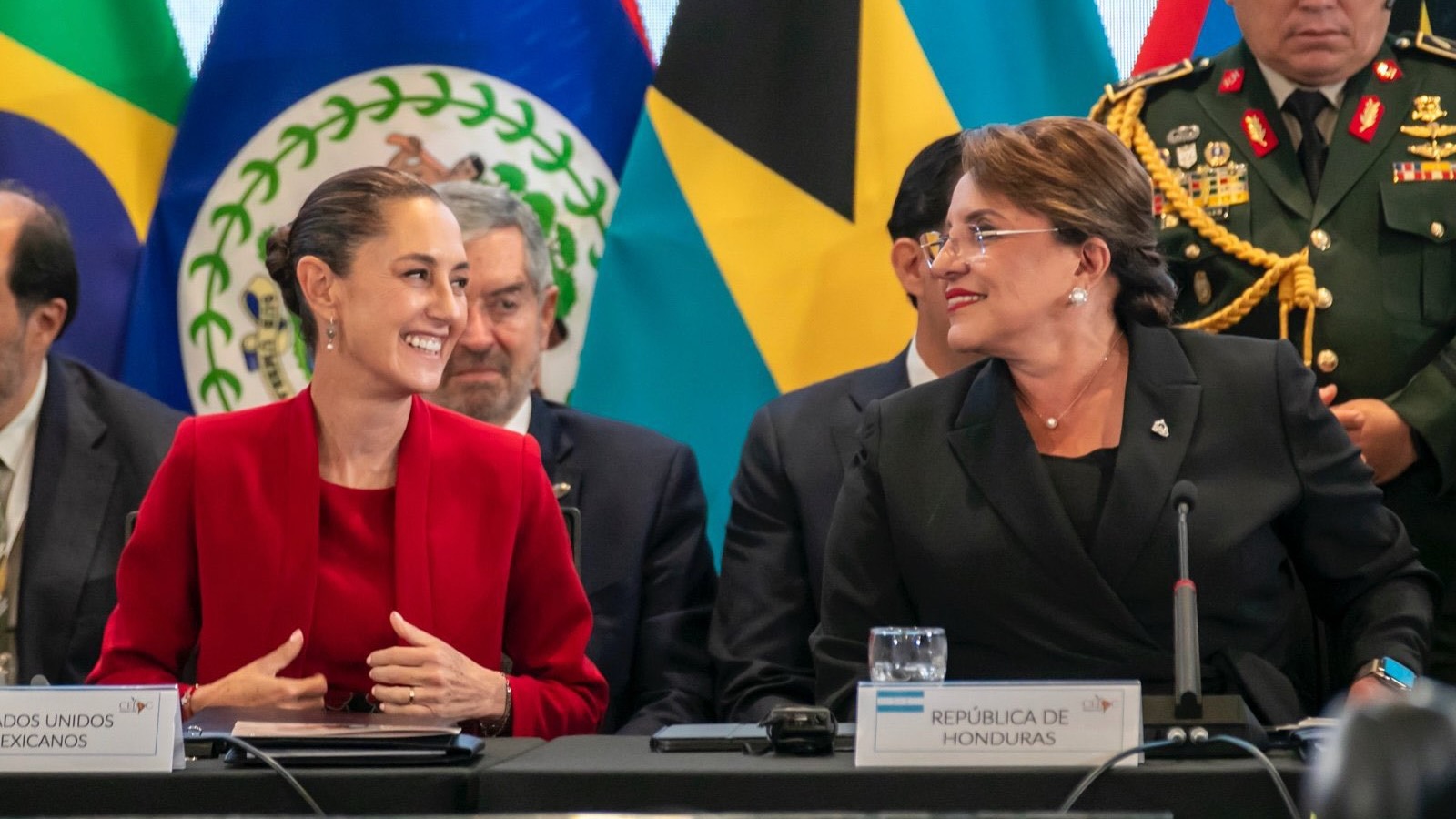
Mexican President Claudia Sheinbaum and Honduran President Xiomara Castro at the annual CELAC summit in Tegucigalpa. Photo: Xiomara Castro/X
After several months of preparation and three days of intense meetings at the highest diplomatic level, the IX Summit of the Community of Latin American and Caribbean States (CELAC), which brings together the 33 countries of the region, concluded in Tegucigalpa, Honduras on April 9.
The high-level meeting concluded with a joint agreement called the Declaration of Tegucigalpa, which was signed by 30 of the 33 member states. Argentina and Paraguay refused to sign the agreement, in line with the foreign policy of the ultra-right-wing Javier Milei and the right-wing Santiago Peña, who reject any attempt at regional unity outside the United States.
For its part, Nicaragua opposed the signing of the document because it considered it inappropriate that it does not support the defense of Cuba and Venezuela, as well as a clear condemnation of the Palestinian genocide.
The key points of the Declaration of Tegucigalpa
Among the most important points of the agreement are:
- Committing to strengthening CELAC as a method for political concentration among member countries.
- Highlighting Latin America and the Caribbean as “a Zone of Peace” adhering to the principles of the UN Charter, International Law, democracy, multilateralism, human rights, self-determination of countries, sovereignty, and territorial integrity.
- Rejecting unilateral coercive measures, contrary to international law, including those of a commercial nature.
- To join efforts toward ensuring that someone from Latin America and the Caribbean becomes the next Secretary General of the UN.
- Congratulating Honduras for its management at the head of CELAC and hand over the Presidency pro tempore of the organization to Colombia for one year to carry out projects related to “energy (energy transition and interconnection); human mobility; health and health self-sufficiency; environment and climate change; Indigenous peoples and Afro-descendants; science, technology and innovation; connectivity and infrastructure; strengthening of trade and investment; transnational organized crime; education; gender equality; among others.”
- Supporting Haiti and endorsing the support of each of the countries, according to their capacities to “reestablish an environment of human security” that allows for the normalization ‘“Of the political, economic, and social situation, with a comprehensive development approach.”
The ghost of Trump at the meeting
Undoubtedly, the recent tariff and immigration measures of Donald Trump’s administration marked a good part of the concerns of the presidents, foreign ministers, and prime ministers who attended Tegucigalpa. In a way, CELAC was created to find agreements outside Washington’s direct influence over the region. However, the plurality of political positions, in addition to external political influences in Latin America and the Caribbean, have not allowed the consolidation of a long-term international agenda.
Lula: “Only unity will prevent us from becoming pawns again”
However, despite the differences in political positions that often prevent reaching major agreements, according to the President of Brazil, Luiz Inácio Lula da Silva, the creation of CELAC “Is the most important decision of the region in 500 years… If we remain separated, the Latin American and Caribbean communities run the risk of returning to the condition of a zone of influence in a new division of the globe between superpowers. Latin America and the Caribbean must redefine their place in the emerging global order. We need a structured program of action.”
Lula also indirectly recalled that the unity of the region is imperative at a time when geopolitics is beginning to redefine itself, among other things, due to the decisions of the Trump administration: “Latin America and the Caribbean are currently facing one of the most critical moments in their history. We have come a long way to consolidate our ideals of emancipation; we have abolished slavery, and we have overcome military dictatorships. Now, our autonomy is once again at stake. The moment demands that we put our differences aside. Attempts to restore old hegemonies are looming over the region. History teaches us that trade wars have no winners.”
Petro: “The agenda of solitude has only two names – migration and blockade”
For his part, the President of Colombia, Gustavo Petro, called on the countries to strengthen regional unity in the face of the new US tariff policy, which will hit the region’s exports hard. He also stressed that there are currently two ways of resolving conflicts at the international level: multilateralism (referred to in the final agreement) and “solitude.”
“Today, there is a certain tendency for us to kill each other and live a century of solitude…This is done to preserve a power that no longer does humanity any good…The agenda of solitude has only two names: migration and blockade. The aid agenda is more complex and difficult, but it is much more interesting for all of us present here, representatives of our nations.”
On Trump’s migration policy and the arrival of Venezuelan migrants to El Salvador, Petro said: “The loneliness agenda proposes to treat the migrant as a criminal. Migrants should not arrive in chains to our land, because if we accept a single migrant in chains, not only do we go back to the time of Torrijos, but we go back to the time when the first boatloads of Africans arrived in chains.”
Díaz-Canel: “Only unity can save us”
For his part, the President of Cuba, Miguel Díaz-Canel, said about the IX Summit of CELAC, “The gravity of this hour of multiplied threats demands the multiplication of unitary forces. Only unity can save us. Let us not delay any longer the integration dreamed and fought for, since Bolivar until today, by the bravest sons and daughters of Our America.”
Sheinbaum calls for an economic summit: “Shared prosperity and sovereignty”
Regarding the urgency of finding economic alternatives in the face of an increasingly complex world, the President of Mexico, Claudia Sheinbaum, called for a meeting to discuss possible joint strategies: “I invite you to CELAC to convene a Summit for the Economic Well-being of Latin America and the Caribbean to make greater regional integration a reality based on shared prosperity and respect for our sovereignties… Today more than ever is a good time to recognize that Latin America and the Caribbean require unity and solidarity among its governments and peoples, to strengthen greater regional integration, always within the framework of mutual respect and the observance of sovereignty and independence.”