Global Sumud activists continue hunger strike despite exacerbating conditions in Libya
The crisis has provoked an international outcry, demanding the immediate release of the apprehended activists, who have reportedly been mistreated.
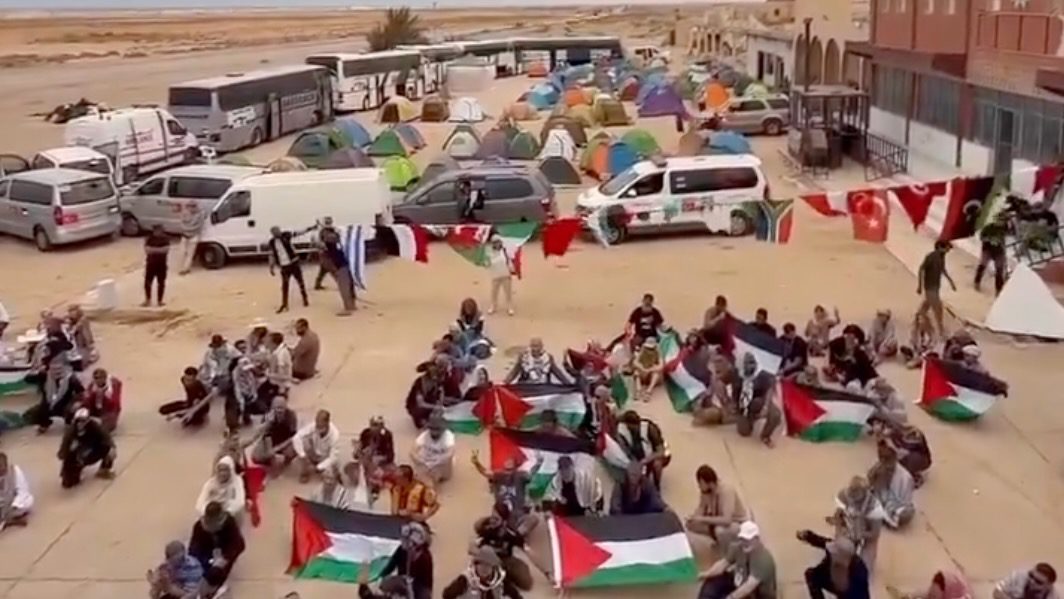
Global Sumud land convoy in Sirte, Libya. Photo: Screenshot
Three weeks after being kidnapped by the Libyan Arab Armed Forces (LAAF), 10 of 11 volunteers of the Gaza-bound Global Sumud land convoy remain unlawfully detained in an immigration facility in Libya’s eastern city of Benghazi.
The Global Sumud Flotilla coalition announced that Mehdi Bouzguenda (from Tunisia), was the only volunteer to be released and return to his country on Sunday, June 7.
The fate of the remaining 10 activists is still uncertain. Refusing both food and water, their ”dry” hunger strike has continued for around 10 days, while they remain barred from communicating with the outside world. At this stage, the “dry” hunger strike is reportedly life threatening.
The detained hunger-striking activists are:
- Achraf Khoja (Tunisia)
- Lucas Ezequiel Aguilera (Argentina)
- Maria Paula Giménez (Argentina)
- Ana Margarida França Santana Baptista (Portugal)
- Domenico Centrone (Italy)
- Leonarda “Dina” Alberizia (Italy)
- Jenelle Jones from (United States)
- Matías Álvarez (Uruguay)
- Laura Kwoczała-Alsubaih (Poland)
- Alicia Armesto (Spain)
Although the abducted activists managed to communicate with their families on Thursday, June 4, four days after having started the hunger strike, there has been no information about their health since.
An audio recording of Paula Giménez’s Thursday phone call with her family circulated online demonstrating the poor detention conditions that she and her colleagues endured, and various physical symptoms they developed.
“We went on a dry hunger strike, that’s why we are authorized to call. I passed out and had convulsions, that’s why we ended up being authorized to call. We are calling from the guards’ cell phones,” Giménez said.
“All this time we have been incommunicado. We have received absolutely no information. This is the first time we have communication with the external world. We are in a cage, lying on the floor. For ten days now, we are physically exhausted. The spine, the psyche. This is hell. What we are living is hell, and without eating for four days, in other words it has been terrible,” she continued.
Paula added that neither she nor any of her fellow activists detained in Libya knows what the next step regarding their situation will be, or when they will be released.
Activists from 13 countries launch solidarity hunger strike
In solidarity with the kidnapped humanitarian volunteers, a global hunger strike has been organized by dozens of activists from 13 countries, including Canada, Spain, Italy, the United States, and South Africa. The hunger strikers have urged the governments to intervene to secure the immediate release of the Global Sumud human rights defenders.
Amnesty International demands the immediate release of the 10 activists
On Tuesday, June 9, Amnesty International issued a statement denouncing the arbitrary arrest of the Global Sumud members and demanding their immediate release.
Amnesty described the incident as an enforced disappearance and slammed the LAAF for ordering the pretrial detention of the activists pending investigations into charges of “assembly without authorization.”
The international organization warned that if convicted, the detained activists would face up to “six months in prison and/or a fine.”
“At a time when Palestinians in the Gaza Strip are grappling with Israel’s ongoing genocide and catastrophic humanitarian conditions, it is utterly disgraceful that individuals seeking to deliver humanitarian assistance and end Israel’s unlawful blockade have been met with arbitrary detention, enforced disappearance and prosecution on bogus charges in Libya,” Mahmoud Shalaby, regional researcher at Amnesty International, noted.
“No one should be punished for undertaking peaceful humanitarian action and trying to stop human rights abuses. The Libyan Arab Armed Forces must ensure the immediate and unconditional release of the activists, and in the meantime ensure that they have prompt and regular access to their families, consular representatives, lawyers and any medical care they require,” Shalaby emphasized.