One month after the tragic earthquakes, Venezuela’s recovery faces obstacles
One month after the twin earthquakes struck Venezuela, the country faces serious challenges in the rebuilding process as it struggles to gain access to its sovereign funds.
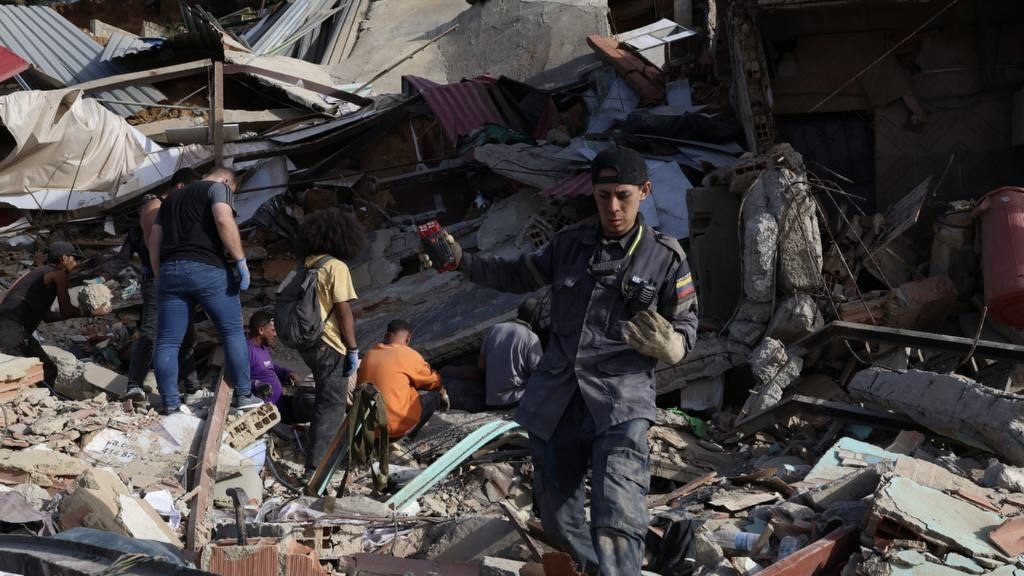
Venezuelan rescue workers in La Guaira. Photo: Jorge Rodríguez / Telegram
Venezuela is still trying to come to terms with the tragedy caused by the twin earthquakes that struck Venezuela’s northern regions of La Guaira and Caracas, one month ago, on June 24. The initial news reports on the two earthquakes, measuring 7.2 and 7.5 on the Richter scale, with just 39 seconds between them, reported the deaths and disappearances of thousands of people and the terrifying collapse of dozens of buildings in a matter of seconds, yet this merely foreshadowed a tragedy whose magnitude continued to grow.
According to official data provided by Jorge Rodríguez, President of the National Assembly, there have so far been 5,398 reported deaths, 16,740 injured, and nearly 29,000 people missing (though the UN states the number could be higher). This is in addition to more than 190 collapsed buildings and 856 severely damaged ones.
A few days ago, the Venezuelan government asked the families of missing persons to provide DNA samples in an effort to identify bodies currently in morgues. Thousands of people are still trying to find their loved ones.
In addition, 17,907 people have lost their homes, and nearly 23,335 are living in 107 temporary shelters, while almost 25,000 children are unable to attend school. According to authorities, nearly 41,069 people have received medical care. This has occurred while nearly 1,463 aftershocks have been detected.
In total, material damages are estimated to amount to a staggering figure: nearly 19.6 billion dollars, according to the World Bank. This represents roughly 17.6% of Venezuela’s GDP, a figure that demonstrates the magnitude of the material losses following the earthquake.
Serious financing problems
Faced with this reality, many are asking: How will Venezuela be able to recover from this blow? For several years, Venezuela has been subject to various economic sanctions and political pressure from Washington and its allies, who oppose the government of the United Socialist Party of Venezuela. This, among other problems, has deepened an economic crisis from which Venezuela has not yet been able to fully recover, leading to a crisis in the supply of goods needed to address the earthquake.
The government of acting President Delcy Rodríguez has requested the release of Venezuela’s foreign currency reserves, which have been confiscated from the Venezuelan government because of US sanctions, to try to alleviate the earthquake’s devastation. However, Washington – which has significantly increased its presence in Venezuela following the January 3 attack and to some extent controls the Caribbean nation’s oil exports – has yet to comment on the matter.
Thus, Venezuela must not only face the tragedy of thousands of citizens and the destruction of their homes, but also a severe economic crisis triggered by the natural disaster. According to the Norwegian Refugee Council (NRC), only 39% of the humanitarian response currently underway in the country has funding.
In this regard, the NGO stated that nearly 1.3 million people require immediate humanitarian assistance in the wake of the earthquake, and nearly 6.2 million will require some form of assistance over the next six months.
Initially, the international community’s response was swift. Dozens of countries sent medicine, food, clothing, and other supplies, as well as their elite rescue teams to assist with the emergency. However, as is often the case, international aid does not usually continue at a substantial level for very long.
Elena Vicario, director of the NRC in Venezuela, reported: “The first month after a disaster usually generates global solidarity and attention. The real test now is whether that support will continue once the headlines begin to fade.”
In addition, Vicario called on the international community to increase aid and investment in Venezuela to help a severely battered country facing an uncertain future move forward: “One month later, those affected by the earthquakes continue to live with uncertainty every day.”