The ruins of neoliberalism and militarism in Asia
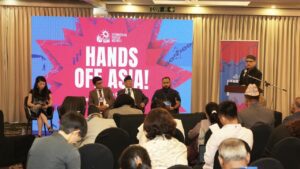
The “Hands Off Asia” Conference featured panel discussions on debt, financial systems as undermining sovereignty, militarism, the fight against the right, and solidarity with Cuba.
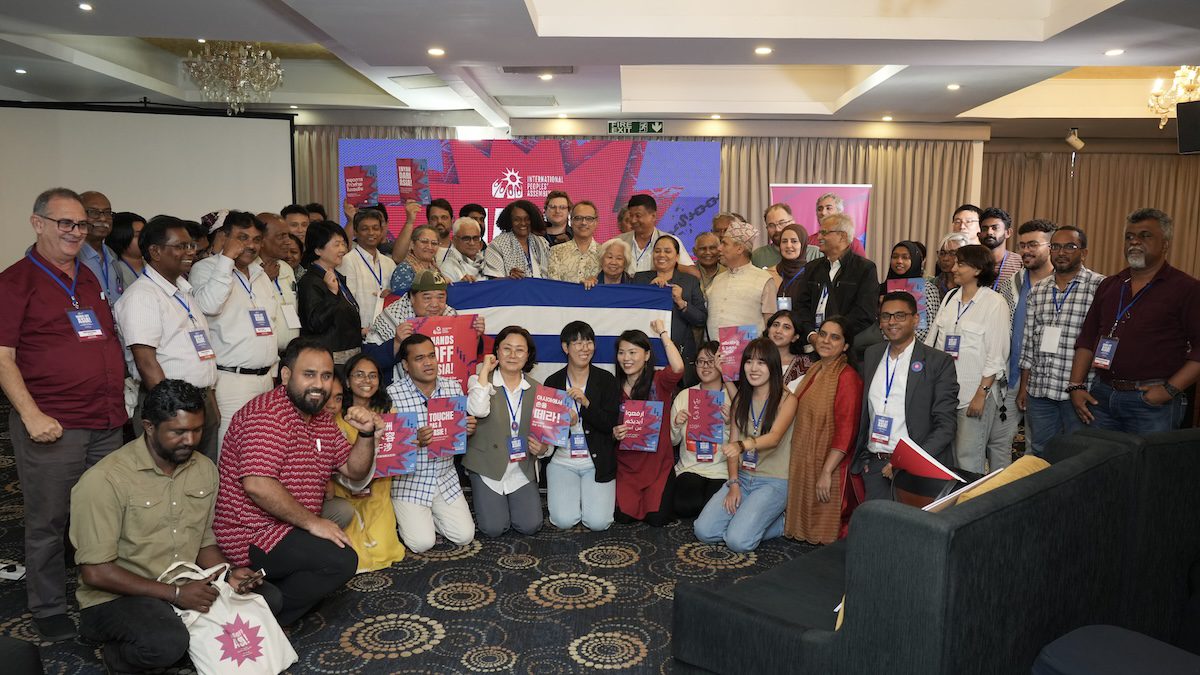
Cuba solidarity at Hands off Asia. Photo: IPA
“All along the Sri Lankan coast, you’ll see old forts. These are the forts of the various colonial powers – the Portuguese, the Dutch, and the English. They are in ruins. There are now proposals to restore them and beautify them for tourism purposes. But actually, they should be left just as they are, ruins. Because that is the only true legacy that colonialism deserves in Sri Lanka.” Dr. Ahilan Kadirgamar, senior lecturer in the Department of Sociology at the University of Jaffna, Sri Lanka made this striking statement at the “Hands Off Asia” Conference in Colombo, Sri Lanka..
Dr Kadirgamar was speaking at the session entitled “Debt, Tariffs and the New Economic Siege: Sovereignty Under Assault”, which also featured Jeong-eun Hwang of the International Strategy Center, South Korea; Taimur Rahman of the Mazdoor Kisan Party of Pakistan; Jeff Xiong of the Centre for Global South Studies, China; and Nicholas Dobrijevic of Red Spark, Australia. The session was chaired by Srujana Bodapati of Tricontinental, India.
The panelists reflected on how the economic policies of many countries in the Global South were determined not on their land, but in Washington DC. Debt and tariff regimes are two of the most common instruments used by the imperialist countries led by the US to drain wealth away from the countries of the Global South. Taimur Rahman put a number to this – between 1960 to now, the magnitude of the drain is estimated to be USD 152 trillion. That is, over USD 2.3 trillion a year, leaving little doubt as to why currently, 54 countries of the world are in extreme distress resulting from a debt crisis.
This global system of extraction of wealth from the poor to the rich is enforced by the interconnected matrixes of financial institutions and banks on the one hand and US military bases on the other, something that Jeong-eun Hwang explained lucidly. She spoke about how South Korea, one of the ten largest economies of the world and a long-time loyal ally of the US with over 28,000 US troops on its soil, is still not inoculated from the pressure of Trump’s tariffs. Nicholas Dobrijevic explained how Australia, itself a settler colony, went from being a junior partner to British imperialism to becoming a junior partner to US imperialism. Today, Australia is used by the US to exert pressure on China. This has its own contradiction, he said, because China is also the largest export market for Australia.
In what could have been a cheerless session, Jeff Xiong provided hope. Speaking of AI, he explained how the US blockade of China for semiconductor parts has failed. Rather than Chinese companies such as Huawei wilting under the pressure of the blockade, China has expanded its productive capacities and has in fact come up with AI models that are extremely cheap – only about 1% of the cost of AI models developed by Silicon Valley. Giving the example of the Brazilian Landless Rural Workers’ Movement (MST) which has trained its cadre to use AI to benefit the movement, he made a plea for democratizing AI by having millions of “barefoot AI developers” on the lines of “barefoot doctors” of rural China.
The day also featured session on “The Far Right, Authoritarianism, and the Domestic Infrastructure of Empire”, with Dr. Hilmar Farid of the Megawati Institute, Indonesia; Fatima Shehzad of the Progressive Students’ Federation, Pakistan; Muhammad Zikri Bin Abdul Rahman of Pusat Serarah, Malaysia; Aishe Ghosh, Jawaharlal Nehru University, India; and Khyl Ashlee Ramos of the Party of the Labouring Masses (PLM), Philippines. The session was chaired by Ambedkar Pindiga of Tricontinental, India.
The panelists spoke about the architecture of coercion and hegemony that the right wing is seeking to erect in their respective countries; the coups against movements seeking to assert sovereignty in countries such as Iran and Indonesia; the alliance between the clergy and the military in countries such as Pakistan and Malaysia; the rise of strongmen (and women) of the far right in countries such as Philippines and India; as well as the resistance to it from people’s movements, particularly from students and young people.
The final session of the day was dedicated to solidarity with Cuba. The Ambassador of Cuba to Sri Lanka, H.E. Patricia Pego Guerra was the main speaker. The other speakers were the senior Sri Lankan leader Vasudeva Nanayakkara; Ramis Suhel of the Mazdoor Kisan Party, Pakistan; and Indian journalist R. Prasanth. Ms. Patricia Pego Guerra spoke eloquently about the unimaginable challenges being faced by the Cuban people today as a result of the Trump administration tightening the blockade to a hitherto unprecedented level. “This is certainly the most difficult period we have faced in our history,” she said. At the same time, she said that the Cuban people know and derive great strength from the fact that the vast majority of the world’s nations, and the overwhelming majority of the world’s people stand firmly with Cuba.
The other speakers paid glowing tributes to the Cuban revolution and the internationalist spirit of the Cuban people. There is no doubt that Cuba is a beacon of hope and inspiration for people fighting for their rights all over the world. The day concluded with participants raising slogans against imperialism and in solidarity with the people of Cuba. As Dr. Ahilan Kadirgamar had so eloquently put it in the opening session, the people of the world look forward to US military bases also turning to ruins, just like the old colonial forts of Sri Lanka.