China adds over a dozen Japanese companies to its export control list, warning against re-militarization efforts
China argues that Japanese remilitarization and revivalism would threaten peace in the region, calling for immediate international intervention against it.
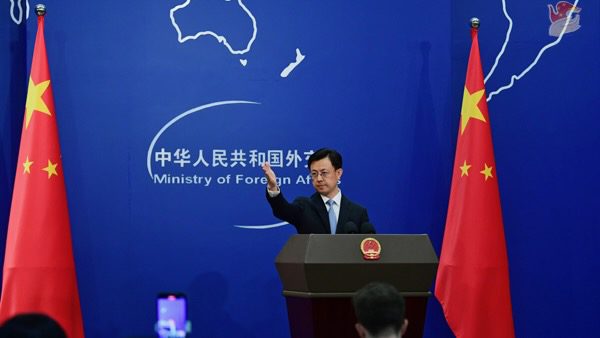
Foreign ministry spokesperson Guo Jiakun’s regular press conference on June 29, 2026. Photo: MFA China
On Monday, June 29, China’s Ministry of Commerce added 20 Japanese entities, including its National Institute of Defense Studies and multiple Mitsubishi-affiliated defense contractors to its export control list in its latest step to stop its move towards re-militarization.
The ministry claimed the move is to “safeguard national security and interest and fulfill international obligations such as non-proliferation,” Xinhua reported.
The prohibition is aimed to stop the export of all dual-use items of Chinese origin to the entities in the list. It prevents any overseas companies or individuals from transferring such items to the listed entities. All existing contracts or transactions are also halted with immediate effect.
Dual-use items are goods, technologies, and materials, such as rare earth minerals, which can be used for both civilian and military purposes.
In addition, the ministry also listed 20 more entities, including multiple companies affiliated with Mitsui, on a watch list for their alleged links to the Japanese military and the potential of using Chinese items to enhance Japan’s military capabilities.
“It is fully justified, legitimate and lawful for China to take these measures which aim to contain Japan’s reckless moves to neo-militarism,” said Guo Jiakun, official spokesperson of the Chinese Ministry of Foreign Affairs, in a press conference on Monday.
He further assured that China’s “lawful” action “only targets a small number of Japanese entities. The relevant measures target only dual-use items, and will not affect the normal business exchanges” between both the countries.
The motive of the move is to warn Japan “to turn back from the wrong path, correct its wrong doings, do serious soul-searching and go back to the right track,” Guo underlined.
China had initiated similar export control moves against 20 Japanese entities first in February this year. The list had included Mitsubishi’s shipbuilding arm as well.
Japan reacted to the Chinese move on Monday, calling it unacceptable and regrettable.
Japan’s re-militarization and the new cold war
The Chinese Ministry of Commerce noted that, despite repeated warnings in the past, Japan has refused to correct its ways and continued with the militarization and deployment of offensive weapons inside and outside its borders.
Experts have warned that Japan has become a central part of the US “new cold war against China.”
This has been accelerated by the surge of the right wing’s popularity in the country, which talks about the revival of the same national glory widely held responsible for the colonial period of Japanese history and the atrocities during World War II.
In the last few years, successive Japanese administrations have pushed the idea of national revival and vowed to increase defense spending, invest in weapons and development programs, and have actively participated in mammoth US-led multinational military exercises in the region.
For the first time in its history, Japan deployed long-range missiles in March this year. It fired its first surface-to-ship missile while participating in this year’s Balikatan exercise in the Philippines.
The nationalist right wing in Japan has also been pushing for the development of nuclear weapons by the country, which remains the sole victim in the world of such weapons.
China maintains that Japan’s aggressive attempts to militarize threaten the post-World War II arrangements and destabilizes the region.
Read more: China warns that growing Japanese militarization threatens world peace
Japanese re-armament will also lead to an arms race in the region, China has claimed, demanding an immediate international intervention in the matter.
Relations between the two countries further deteriorated after Prime Minister Sanae Takaichi, immediately after assuming office, threatened China with military action if it used force to reintegrate Taiwan.
Despite Japan officially recognizing it as a part of China, Takaichi claimed that any Chinese military action in Taiwan would be considered an “existential crisis” for her country.
China demanded an apology and the retraction of the statement, calling it a violation of the One-China policy and an interference in its internal affairs.
Read more: Japan’s Taiwan hysteria reveals a dark imperial legacy
However, despite her statement causing prolonged diplomatic tension and economic hurdles for the country, Takaichi refused to apologize or retract the statement, merely saying that she would not repeat it in the future.