Peru’s Fujimori leads over Sánchez with less than 1% of ballots left to count
Sánchez has alleged irregularities in the count, but he would need nearly 1 million dollars to challenge polling stations with irregular counts.
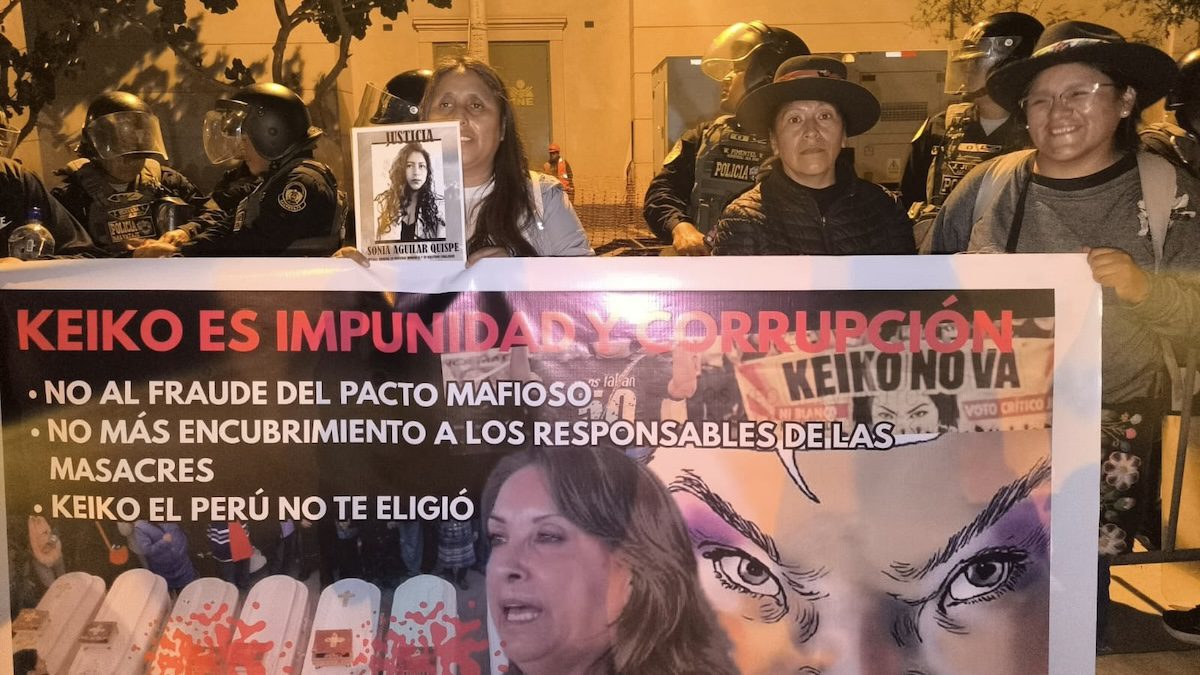
Protesters in Lima, Peru condemn irregularities in the second-round elections. Photo: Telesur
With nearly 99.082% of the ballots counted, Peru is nearing the conclusion of a tumultuous presidential election. After a long wait following the first round, held on April 12 – due to the close margin of votes between the second and third-place candidates – Peruvians have now had to wait on the edge of their seats for the official results of the runoff.
Both candidates have also maintained a tense sense of caution in the face of the initial results, which showed the race to be nearly tied following the June 7 runoff. The far-right candidate from Fuerza Popular, Keiko Fujimori, has secured a tiny but significant lead over the candidate from Together for Peru (JP), the leftist Roberto Sánchez.
In fact, with less than 1% of the ballots remaining to be counted, Fujimori, the daughter of former dictator Alberto Fujimori, has reached 50.097%, or 9,129,316 votes so far, while Sánchez has so far received 9,093,792 votes, or 49.903%. Thus, Fujimori leads Sánchez by just 35,524 votes, with less than 1% of ballots remaining to be counted.
And while that margin might seem small in an electorate of more than 18 million voters, the truth is that the count has been so close that both campaigns have already acknowledged that the result would be extremely tight, but that is ultimately the situation in Peru.
Keiko Fujimori, who has proposed a radicalization of the neoliberal model in Peru and a heavy-handed security policy, has run for president on three previous occasions. According to some analysts, this would be Fujimori’s best chance to win a highly volatile presidency (eight presidents have held office in the last 10 years, reflecting the serious political crisis of legitimacy facing the Andean country).
An “expensive” electoral system and suspicions of irregularities
For his part, Roberto Sánchez asked Fujimori to recount all the votes to ensure the absolute certainty of the result, to which Fujimori flatly refused. One might wonder why Sánchez’s team doesn’t simply challenge all the vote tally sheets to see if they can catch up to Fujimori. Well, because in Peru, challenging a vote tally sheet costs a lot of money.
Sánchez and his team have reported serious irregularities in the vote tally, but they lack the funds to challenge those ballots. Without a wealthy sponsor, Juntos Por el Perú has launched a campaign to challenge 2,400 polling stations where they identified serious errors. However, to do so, they need nearly USD 1 million, as each contested polling station costs 1,337 soles (approximately 393 USD).
According to Alfredo Serrano Manc, director of the Strategic Center for Latin America: “The cost of demanding democratic transparency was estimated at nearly one million dollars. If you don’t have that money, then you’re left unable to demand transparency,” which, he stated, reveals a system that is completely commercialized.
“Can an election be lost over $925,000? The answer is YES. In a democracy as commercialized as Peru’s, filing a challenge to the election results comes at a price … In a race as close as the current one, the ‘purchasing power’ of each candidate is decisive. In conclusion: a disgrace that adds to so many other disgraces that are leaving democracy as corrupt as it is hollow,” said Serrano Manc on X.
In this regard, several groups supporting Sánchez’s candidacy took to the streets to demand greater democratic transparency. Protests were held in the capital, Lima, as well as in Chiclayo, Arequipa, Puno, Ayacucho, and other cities.
In response, Peru’s interim president, José María Balcazar, decided to cut short a planned trip to Europe to “ensure public peace,” a move that could be seen as a way to prevent protests in a country that, four years ago, witnessed massive demonstrations against the coup d’état carried out against then-President Pedro Castillo (now imprisoned), whom Sánchez has described as his most loyal supporter and whose platform he has upheld.
In this regard, Sánchez and his campaign face an unfavorable situation, due both to his party’s financial constraints and to an institutional apparatus that appears to have closed ranks behind Fujimori.