‘Peru is experiencing a technical draw and exposing an extreme fracture,’ says international analyst
Gustavo Menon states that Peruvians need to decide between two completely antagonistic projects.
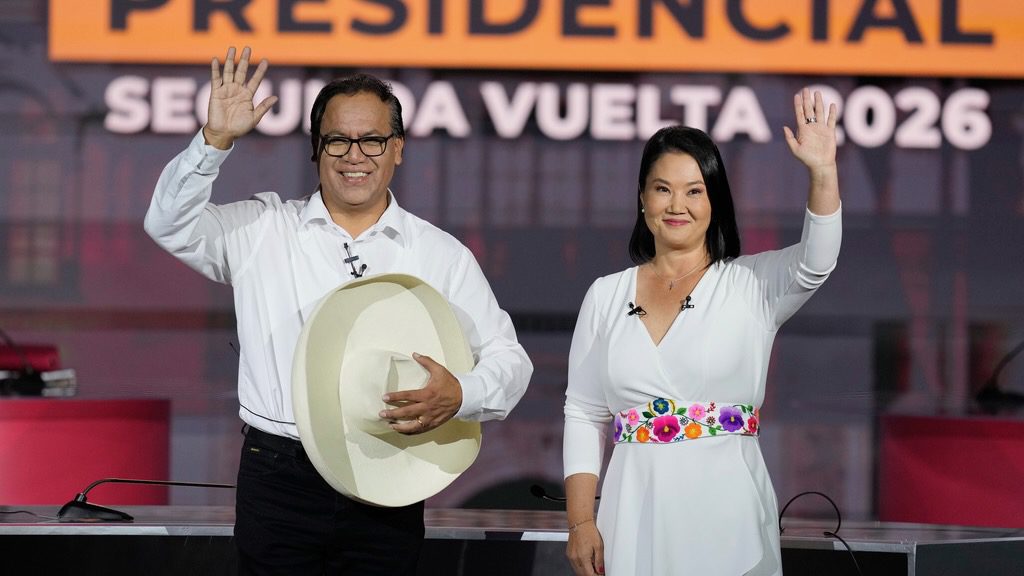
Presidential candidate Keiko Fujimori of the Popular Force party and her rival Roberto Sanchez of Together for Peru party wave during a presidential debate, in Lima, Peru, Sunday, May 31, 2026. Photo: AP
The presidential election in Peru, which has been full of dramatic contours, is still undecided and remains a close race. At this moment, the vote count is showing the far-right Keiko Fujimori in the lead over her opponent, leftist Roberto Sánchez. Since Sunday, both have swapped positions several times during the count, but the daughter of former dictator Alberto Fujimori gained an advantage on Thursday, June 11 because of the overseas Peruvian voters.
According to Gustavo Menon, a professor at the Catholic University of Brasília (UCB) in Brazil, the so-called vote-by-vote dispute can be understood in light of the Peruvian population’s distrust of the country’s recent history. “This electoral process is intensifying in the expression of these two totally antagonistic projects: on one side, Fujimorism, and on the other, the strength of Roberto Sánchez in the so-called Upper Peru region, insofar as his votes are concentrated in this mountainous region, in cities like Puno and Cusco. This is Roberto Sánchez’s main electoral stronghold. It is very likely that this vote count will expand in the coming hours. And note that the votes from abroad were decisive in these last few hours. And this is a very emblematic scenario in the current situation. We are talking about 759 votes separating Keiko Fujimori and Roberto Sánchez. It is a scenario of a technical tie and an extremely fractured Peru,” he assesses.
The professor highlights the wide lead that the far-right candidate has in the capital, Lima, and other important coastal cities. “If Keiko Fujimori’s election is confirmed, there will be a move closer to Trumpism and a strengthening of the Shield of the Americas,” he points out.
Menon believes that, regardless of the winner, the future president will face an immense challenge: reaching an agreement with parliament. “He will have a lot of work to do with the Peruvian Congress, where we know that the Peruvian political system is a sham presidential system. The National Congress has considerable power to remove successive presidents. I draw attention to the process against Pedro Castillo, elected in 2021 … this is a decisive moment as the last ballots are being counted,” he states.
First published by Brasil de Fato in Portuguese.