Colombian government decries ‘illegal’ bid to suspend Petro amid presidential election
The decision, which has been categorically rejected by the Executive Branch, comes nearly 10 days before the second round of the election pitting progressive Iván Cepeda, against far-right candidate Abelardo de la Espriella.
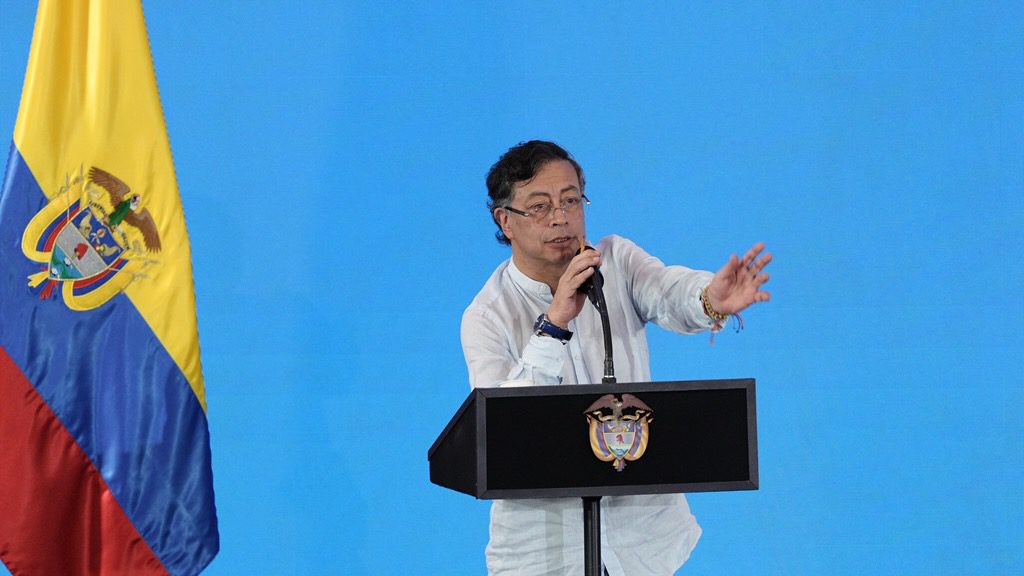
Colombian President Gustavo Petro. Photo: AP
On Wednesday, June 10, while Colombian President Gustavo Petro focused on delivering a message to the Security Council, Gloria Arizabaleta, the chair of the Colombian Congress’s Investigation and Impeachment Committee, ordered the “provisional suspension” of President Petro until the second round of the Colombian presidential election concludes.
The Colombian president was at the United Nations, because yesterday, Colombia officially assumes the presidency of the UN Security Council. In his speech in New York, Petro warned of the importance of regulating AI to prevent the spread of hate speech.
According to Arizabaleta, Petro allegedly participated actively in campaign activities during the election period in support of center-left candidate Iván Cepeda, Petro’s political ally, who will face far-right candidate Abelardo de la Espriella on June 21 to decide the future of the Colombian presidency. The Commission Chair says Petro’s statements constitute a “very serious offense.”
What has likely drawn the most attention is that Arizabaleta belongs to the same party as Petro and Cepeda, the Pacto Histórico, which has sparked a flood of speculation on social media and in the media. The Commission’s president argued that she has the authority to issue the suspension because there are “serious grounds for believing that remaining in the position, role, or public service would allow the perpetrator of the misconduct to interfere with the investigation.”
The Executive Branch has reacted swiftly to the attempt to suspend Petro. Interior Minister Armando Benedetti described the suspension order, which has been signed only by Arizabaleta, as “illegal and improper,” since, as he stated, a branch of Congress performs only strictly investigative functions and cannot assume powers such as the temporary suspension of an elected official.
According to the Executive Branch, the move is nothing more than a “political maneuver with no constitutional basis” taking place in the midst of an election campaign that has polarized the country, and in which candidates are vying for the few votes that will decide an election that several experts describe as extremely close.
Benedetti also clarified that the measure of temporary suspension can only be carried out by the Senate as a whole, following action by the House of Representatives, which is considered under Colombian law to be the prosecuting body in criminal and disciplinary matters. Thus, according to the Executive Branch, Article 194 of the Colombian Constitution establishes that the suspension of the president can only be decreed by the Senate.
In this regard, it does not appear that the Executive Branch will comply with Arizabaleta’s unilateral decision, which could open up several scenarios that presidential candidates might exploit to win more votes in an election campaign in which Colombia must decide between the continuation of progressivism and the building of a welfare state, or a radical neoliberalism allied with Washington that has already promised a 40% reduction of the Colombian state and the suspension of the peace policies of previous governments.