‘We are all in this fight together’: farmers rally against Bangalore’s expanding AI-powered satellite city
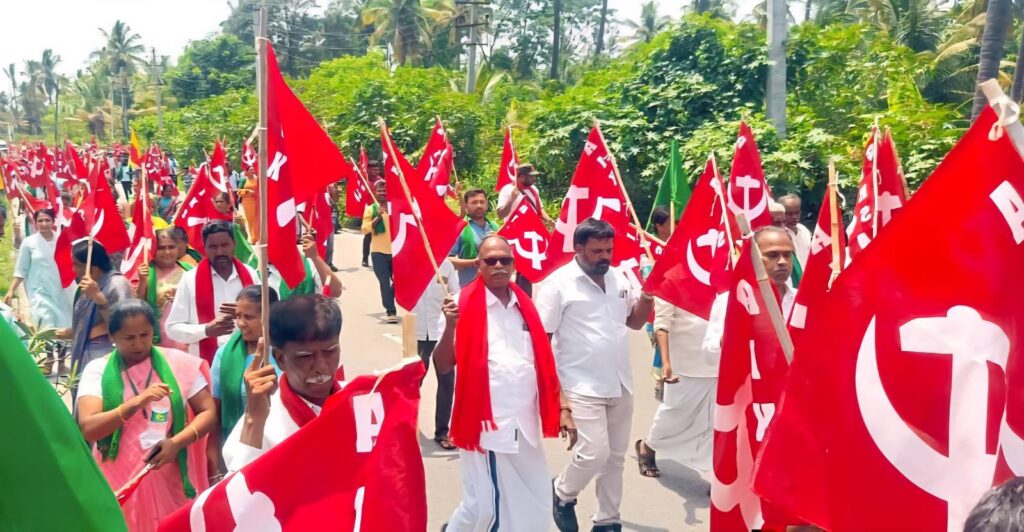
Arriving in solidarity from several villages around Bangalore, farmers marched with red flags to join the protest defending 9,600 acres of fertile, irrigated, multi-cropped land from acquisition to expand the city.
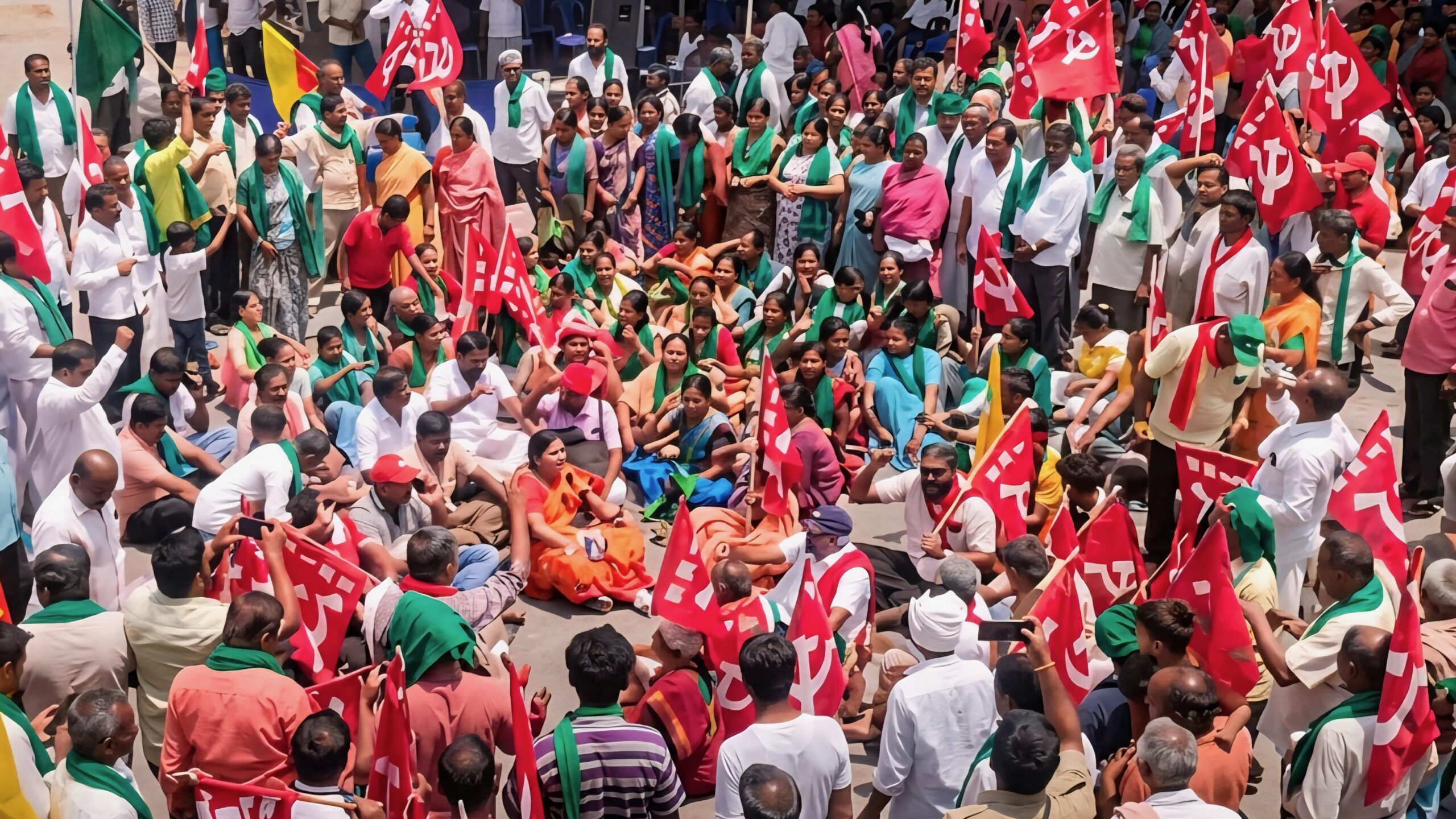
Farmers occupy Byramangala roundabout. Photo: AIKS
On May 29, the 440th day of a protest resisting the acquisition of over 9,600 acres of fertile, irrigated, multi-cropped land in southern India to expand Karnataka state’s capital, Bangalore, farmers from several districts joined the demonstration in solidarity.
Arriving from villages around several cities and towns neighboring Bangalore, hundreds of farmers assembled at the bus depot in Abbanakuppe village, about 40km southwest of Bangalore, in Ramanagara district.
From the adjoining Bidadi industrial area, scores of unionized workers also joined the farmers who, carrying the red flags of the farmers’ union All India Kisan Sabha (AIKS), marched 3 km to the Byramangala roundabout.
Farmers in the Gram Panchayats (village councils) of Byramangala and Kanchugaranahalli have been protesting at this roundabout since March 2025, when the state government issued the preliminary notification for the land acquisition.
To decongest the state capital, Bangalore, the government intends to build a second business district here, touting the Bidadi Township project as India’s first AI-powered “work-live-play” themed city.
“If the government genuinely wants to bring about development, let them come to northern Karnataka,” said 44-year-old Raghav Reddy, himself a migrant from the region. “My family has 12 acres in Gulbarga. But a farmer with just two acres of this fertile land here produces more than what we can on 12 acres there.”
Unable to sustain on agriculture in the arid north, he came to Bangalore looking for work and found employment at the nearby Toyota Kirloskar Auto Parts, where he has been working for the last 21 years.
“If the government had built industries on the barren lands in Gulbarga and created jobs, I wouldn’t have had to leave my family behind and come to Bangalore. But the government is not interested in building industries there,” because the politicians find the margin for real estate profiteering there very low, argues Reddy. “So they instead want to grab this green land and destroy farming communities.”
A leader of his factory union, he was heading a delegation of about 50 uniformed auto parts-producing workers who, along with workers from the Coca-Cola factory, marched with the farmers.
On either side of the road are lakes and farmlands towered over by coconut trees and timber. Arcanuts, mangoes, sapotas, and a myriad of other fruits blossom beneath, over trees shading the vegetables, growing alongside dense patches of napier for cows and mulberry for silkworms.
The twenty-odd villages of the two gram panchayats marked for acquisition account for a large portion of sericulture in Ramanagara district, which is Karnataka’s largest silk producer. Feeding and raising tens of thousands of cows, farmers here not only cater to the local dairy needs of about 20,000 people but also supply the Karnataka Cooperative Milk Producers’ Federation with at least 600,000 liters of surplus milk per month.
Farmers refuse monetary compensation
As compensation for uprooting their livelihoods, the government has offered Rs. 2-2.5 crore per acre. But Nagesh, a middle-aged dairy farmer, owns no land at all. Renting an acre from a small farmer owning more than he can cultivate with his family labor, he grows napier to feed the five cows he has raised in the shed adjoining his house.
“Around 30% of the farmers here do not own the land they cultivate,” he said. “The government is offering landless farmers a compensation of Rs. 25,000 per year until the completion of the township. I earn Rs. 50,000 a year only from selling cow dung as manure. I earn another six lakh rupees from selling milk.”
Displacing this income of 6.5 lakh rupees per annum, which places his household in the top 10% of India’s income group, the acquisition threatens to leave Nagesh, who knows no other trade, with no livelihood and no means to feed his family or pay for his daughter’s education.
Even the vast majority of land-owning farmers refuse to cede their farms. While the government’s offer of Rs. 2–2.5 crore per acre has enticed a handful of large landlords, the vast majority are small farmers owning anywhere from under half an acre to four acres. The compensation amount for them cannot offset the loss of land as a source of livelihood that has sustained generations before and can sustain more to come.
Even Nagaraju Mandlali, who owns 15 acres and could earn 40 to 45 crore rupees in compensation by ceding his land, refuses what would be considered a fortune in urban India, and explains the agrarian logic.
“Farmland in adjoining areas is presently costing over 5 crore an acre. Even if we relocate a further 100 km from Bangalore to Kollegala and its surrounding areas [near Mysore], an acre costs at least 1.5 crore. And those areas are teeming with wildlife preying on cattle,” he said.
“Here we have no such dangers. We have a year-round water supply from the Vrushabhavati river. We must defend this land at any cost,” to continue agriculture, which, Mandlali insists, is both an economic imperative and a matter of pride for these highly skilled generational farmers who know no other trade.
Read more: ‘We will give our chest to your bullets, but will not cede an inch of our land’: farmers resist city expansion in southern India
“It is their farmlands today, it will be ours tomorrow”
Among the farmers who had joined them in solidarity was a 73-year-old patriarch, Krishnayya, leading a delegation of about 50 farmers from Channapatna, about 40 km further southwest of the notified villages in Byramangala and Kanchugaranahalli.
“If the government succeeds in grabbing their lands, they would be at our doorstep in Channapatna,” where, multi-cropping his 2.5 acres and raising five cows, Krishnayya sustains a family of nine.
“It is their farmlands today, it will be ours tomorrow,” he said. Adding that “the city’s appetite to swallow up farmlands to expand is insatiable,” he makes a comparison to the mythical demon Bakasura. “So we have come here to communicate to the protesting farmers that we are all in this fight together and our solidarity with them is unconditional.”
Farmers also came to express solidarity from further southwest, from Mandya, Mysore, and beyond. Busloads more came in from over 80 km away – from Tumkur, a city to Bangalore’s northeast, Hoskote to its northwest, and from several other towns neighboring Bangalore.
Marching under the scorching sun behind AIKS Joint Secretary, D. Raveendran, and S. Varamalakshmi, the Karnataka General Secretary of Center of Indian Trade Unions (CITU), they arrived at the Byramangala roundabout in the afternoon.
Joined by hundreds of local farmers who also poured in, they gathered around, raising fists to anti-government chants as the farmers’ union and trade union leaders sat on the road, sloganeering – occupying the roundabout, which is a crucial node on the state highway.
The cops did not have sufficient numbers to intervene immediately. Some scrambled for their walkie-talkies. Others jostled in the crowd to record on their phones. Traffic had come to a halt on all connecting roads, cutting off the Bidadi industrial area from where the march had started, to the Harohalli industrial area further ahead.
After a brief demonstration, farmers moved to the sit-in protest at a square in front of a temple at the roundabout, as vehicular movement resumed. Local farmer leaders then welcomed those who had come from afar to support their protest. Welcomed with a particular fanfare were the farmers from Devanahalli, a town on the northern outskirts of Bangalore, near its international airport.
After nearly 1,200 consecutive days of protest, spanning across the rule of two successive state governments led by both of India’s largest bourgeois parties – the BJP and the Congress – the Devanahalli farmers had successfully defended 1,777 acres across 13 villages.
Read more: The saga of peasant resistance: how farmers defeated the land grab by India’s Karnataka state
Months after issuing the final notification for land acquisition, the government was forced to backtrack, denotifying their land in July 2025. Inspired by their victory, this protest movement in Ramangara, only a few months old at the time, escalated into a day-and-night sit-in demonstration that has continued at this square since.
“Welcoming us with honors, they told us: we had assumed it was impossible to force the state to retreat once the notification was issued. It was your victory in Devanahalli that gave us confidence,” said Nanjappa, a veteran of the Devanahalli struggle.
Standing tall and upright in his mid-70s, he explained, “We are here to assure that the farmers from Devanahalli will fight shoulder-to-shoulder with the farmers here. We are ready to go to prison with them. We have faced plenty of police action during our struggle. They do not scare us.”
Recalling that cops often outnumbered the protesting farmers in Devanahalli, “I am still fighting two cases they have filed against me,” he added. “I was arrested twice. But our position was clear: get your hands off our land or imprison us all and seize our land in our absence. There simply was no middle way.”
Announcing the government’s retreat from this land acquisition last July, the then-Chief Minister (CM) Siddaramaiah had acknowledged that Devanahalli farmers, backed by “writers, artists, communist party, [and] people’s movements”, had fought and won a “historic” victory.
State repression under the new chief minister?
However, amid an intensifying power struggle within the Congress party ruling the state, Siddaramaiah resigned on May 28, one day before this protest march. His rough-talking deputy CM, D. K. Shivkumar, who has thrown all his political clout behind the Bidadi Township project, was sworn in as the new CM on June 3 to serve out the remainder of Siddaramaiah’s term.
In the interregnum between the resignation and the swearing-in, conversations among farmers gathered here on May 29 anticipated state repression under Shivkumar’s rule.
“There is no reason to fear or panic,” T. Yashvantha, general secretary of the AIKS-affiliated state farmers union, Karnataka Prantha Raitha Sangha (KPRS), said in his address to the protest. “Even if he becomes the Prime Minister, we will stop his Bidadi Township project, and defend the villages of Byramangala and Kanchugaranahalli,” he declared, drawing cheers from the protesters.
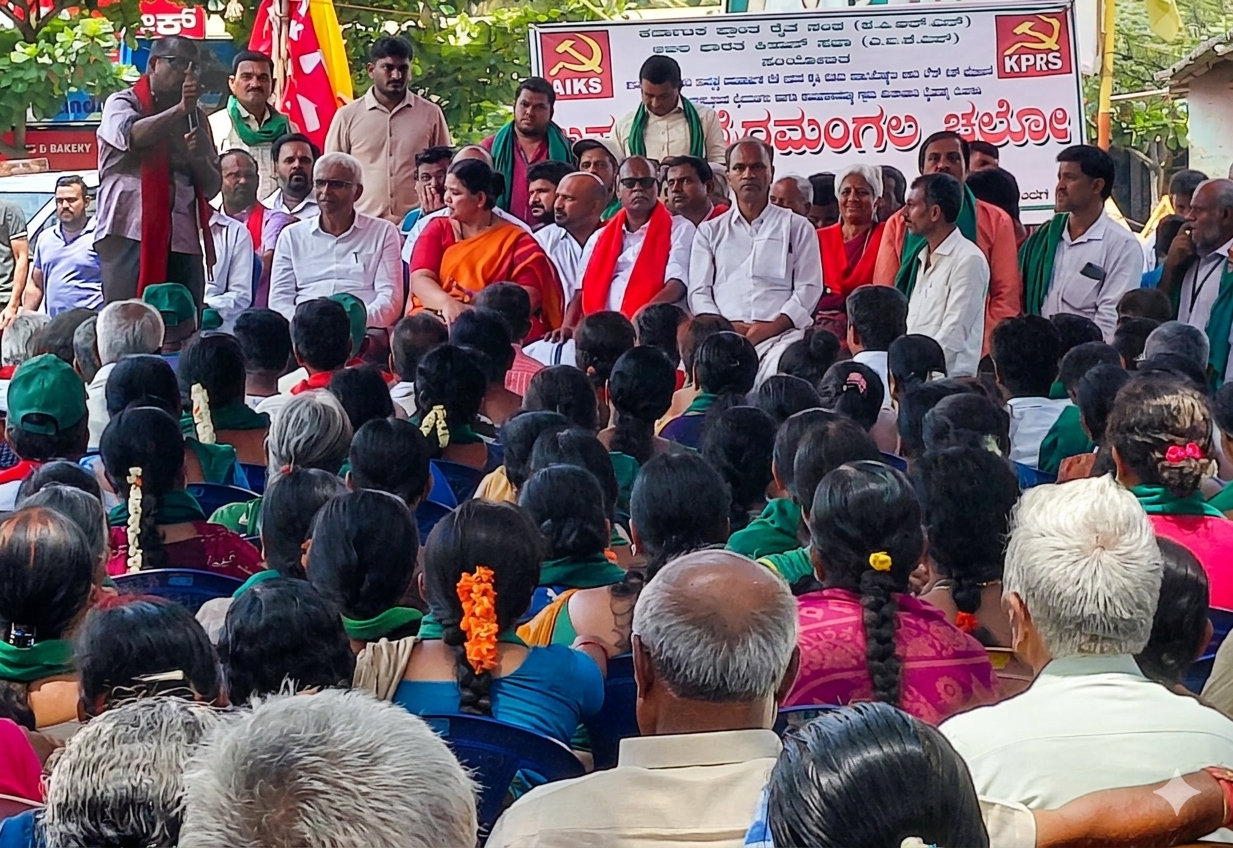
“You are not alone. The KPRS has over 150,000 members across the state. If need be, we will mobilize every single one of them in your support,” vowed Yashvantha, who has played a crucial role in helping the farmers here organize resistance.
“Your struggle is being talked about even in the national capital,” said AIKS leader Raveendran, who had arrived from New Delhi to lead this march and reiterate the support of hundreds of thousands of farmers his organization represents across the states of the country.
“If 3,000 of you mobilize, the KPRS will rally behind you another 2,000 farmers from across the state. 5,000- farmers strong, let us march on foot for over 40 km to Vidhana Souda”, the state legislature in Bangalore. “Let us surround the legislature and refuse to leave until the acquisition notification is scrapped,” he said in his address, as farmers applauded the proposal.
“Job creation through land acquisition is a lie”
“The Karnataka Industrial Areas Development Board (KIADB) has already acquired 1,62,000 acres of farmland across the state. How many of the acres have they actually built industries on?” asked trade unionist Varalakshmi in her address.
“During our visit to the Devanahalli protest last year, we saw that much of the thousands of acres they had already acquired were lying vacant. Where industries are built, locals are never employed,” she said, explaining that employers prefer to hire migrant workers, whose vulnerabilities can be used to keep them in line.
“Only jobs available for locals, the children of farmers who lost the land, are those of security guards and sweepers. They want to reduce skilled and highly productive farmers to sweepers,” she protested, adding, “Even those jobs are contractual, and never on a permanent basis.”
Before notifying any more land for acquisition, “the government must produce a White paper, clearly stating how much land farmland has been acquired so far, how many jobs have been created on that land, and how many of these jobs actually went to farmers’ children,” demanded KPRS Joint Secretary Prantha Belagavi.
“Job creation through land acquisition is a lie,” insisted KPRS president, U Basavaraj. In his hometown of Bellary District, 13,000 acres across seven villages were forcibly acquired in 2010.
“16 years later, there are still no jobs provided to the affected farmers. They were even cheated out of the compensation promised. We have been fighting for their justice since 2010. Many governments have come and gone since. The BJP, Congress, as well as the [regional] JDS party have ruled. All these parties promised justice when in opposition and turned their backs on us once elected.”
Here too, the preliminary notification for land acquisition for Bidadi township was issued in 2006, when the JDS was ruling in coalition with the BJP. However, the acquisition was stalled due to resistance by farmers, for whom the Congress, then in opposition, had extended support. Now, the JDS and BJP are declaring support for the farmers after the Congress government renewed the same project, rebranding it as an AI-powered city.
“Corporations are waging a global war against peasantry”
“We must understand our fight is not against one party or one minister, but against the large multinational corporations. These parties are merely their agents. They opportunistically shed crocodile tears when in opposition and turn against us when in power. We need to understand this political dimension if we are to succeed in our struggle against the MNCs, which are waging a war against the peasantry, not only in your two gram panchayats, not only in Karnataka, but all over India and the world beyond.”
But, reiterated Basavaraj, the peasantry are also resisting fiercely everywhere. “In all regions of Karnataka, farmers displaced from land due to forced acquisition and left on the streets with no livelihood are fighting back and demanding justice. More farmers are fighting to defend their land from more forced acquisition. The KPRS has resolved to unite all these struggles and bring together the farmers protesting across the state to launch a militant agitation in Bangalore,” he announced, receiving an ovation from the farmers.