Eight presidents later, Peru heads into another volatile election
After a presidential debate ahead of elections on June 7, polls show a fairly even race between the right and left-wing candidates.
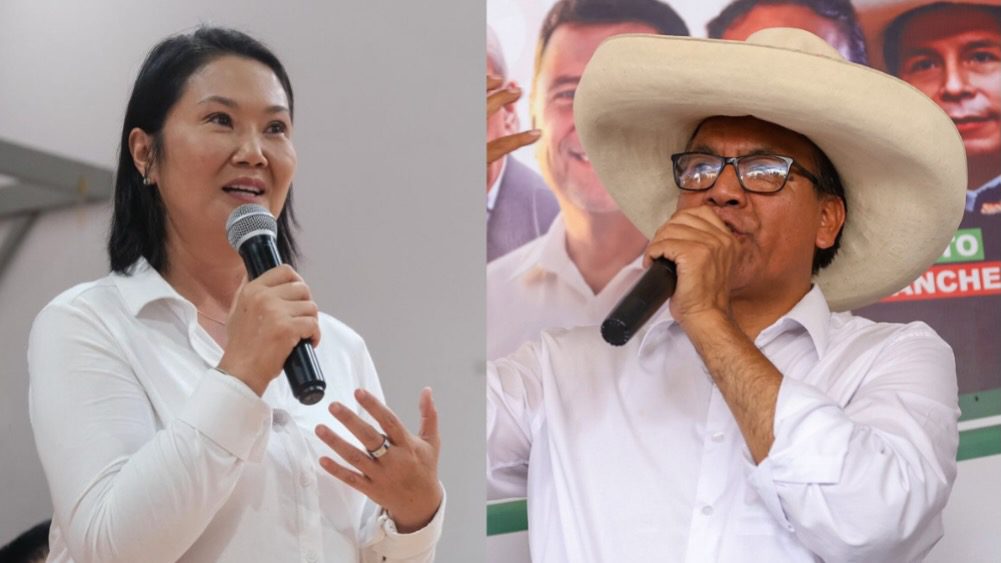
Right-wing presidential candidate Keiko Fujimori and left-wing presidential candidate Roberto Sánchez. Photo: ANDINA
Peru is in the final stretch of the race to elect its next president. After a protracted vote counting process, right-wing candidate Keiko Fujimori (17.9%) and left-wing candidate Roberto Sánchez (12.04%) advanced to the runoff election to be held next Sunday, June 7.
Until the very end, the highest electoral authority had to count contested and delayed votes without being able to declare the winners. The reason was that, in third place, very close behind Sánchez, was the far-right former mayor of Lima, Rafael López Aliaga, who ultimately received 11.91% of the vote and who claimed there was fraud against him, although he never presented conclusive evidence to support his accusations. In fourth place was the center-right candidate Jorge Nieto (10.98%), who has asked his supporters to cast invalid ballots. In fifth place was Ricardo Belmont (10.15%), also a right-winger but an anti-Fujimori figure, who has called for support for Sánchez.
The candidates’ proposals
Thus, Fujimori managed to buy time while Sánchez was embroiled in a controversy with López Aliaga, which took some of Sánchez’s campaign time away – time that Fujimori knew how to capitalize on. Indeed, the Fuerza Popular candidate, constantly invoking the memory of her father, the former dictator Alberto Fujimori, has traveled throughout Peru promoting her hard-line approach to crime and a radical neoliberal agenda.
In addition, she proposes a national pacification plan, which would involve deploying the armed forces on public transportation, the deportation of undocumented immigrants, and the implementation of mandatory labor for prisoners.
For his part, Sánchez – the candidate backed by former President Pedro Castillo, who was deposed by Congress and arrested after attempting to convene a Constituent Assembly – has toured the country appealing to the masses (especially rural farmers). He plans to rebuild the country through an Assembly that would rewrite the neoliberal-leaning constitution in favor of one that supports the working classes, a prospect that has alarmed Peru’s neoliberal establishment.
He has also promised to purge the National Police and ensure that any public officials convicted of corruption will never again be allowed to hold public office. He further stated that under his administration, the government will gradually increase investment in education and health care.
In response to fears across various sectors of Peruvian society, Sánchez has reiterated that he is not a communist and that he will respect existing institutions, including the autonomy of the Central Reserve Bank (following several rumors stemming from a smear campaign).
Polls predict neck and neck race
For now, the polls show a fairly even race. Although several right-wing supporters claimed that if all right-wing votes were combined, Fujimori would easily crush Sánchez, the preliminary numbers seem to paint a different picture.
According to the polling firm IPSOS, counting only valid votes, Fujimori would receive 51.4% of the vote, while Sánchez is very close behind with 48.6% – a difference of just 2.8%.
However, IPSOS, which released its latest poll on May 30 before the ban on publishing polls took effect, also reported that there are still a large number of undecided voters (about 15%) and that while 74% of those surveyed said they had already decided how to vote, 26% said they might change their vote in the final days before the election. In other words, there is still a significant margin of possibility that either the radical right’s lead could hold or widen, or that Sánchez could rally in the polls and that his political camp, aligned with Castillo, could once again win the presidential election in quick succession.
“Ultimately, the outcome will depend on those who voted for candidates who did not advance to the second round and who now say they will cast a blank vote, spoil their ballot, or remain undecided. The logic of the lesser evil will ultimately determine Peru’s president for the 2026–2031 term,” IPSOS stated in its poll report.
A polemic debate
However, the latest polls could shift significantly following the presidential debate between the two candidates, who sought to convince the large number of undecided voters (and those who had previously voted for other candidates) to support their platform.
Keiko Fujimori stuck to her discourse of order and security in an attempt to secure a presidency that has eluded her on three previous occasions, all of which she lost due to the strong resistance her father’s legacy generates among the country’s pro-democracy electorate. “This election is not about me, but about which team is best equipped to bring order to the country. We have everything we need to move forward; we just need to get organized. We will leave behind a country with more jobs and greater security,” Fujimori stated.
Sánchez quickly opted for a direct response in the debate: “What order are you talking about when Peru knows how chaotic things have been since you had a parliamentary majority? You’ve trampled on democracy.”
Furthermore, the Juntos por el Perú candidate constantly reminded Fujimori of the serious human rights violations committed during her father’s term (1990–2000), and the support her political faction gave to Dina Boluarte, Sánchez’s vice president, to whom they handed over power and who suppressed the protests that took place for months against what demonstrators called a “coup d’état.”
Following this, Fujimori decided to strike back, as explained by El País journalist Renzo Gómez, who notes that the debate ended up turning into an exchange of accusations about the past. Sánchez claimed that Fujimori had ‘never worked’ and is embroiled in family conflicts. While Fujimori accused Sánchez, whom she called “a coward”, of having ties to Antauro Humala, who was imprisoned for 18 years for a riot in which four police officers were killed.
For now, it is unclear who will prevail in Peru. Undoubtedly, following the severe delegitimization of the Peruvian political system, many voters will, according to the IPSOS poll, go to the polls and vote for “the lesser evil,” which will immediately cause certain problems for the new president.
Undoubtedly, Peru’s political direction will be decided in a matter of days. The spectacle could deliver a major surprise to a country that has had eight presidents in just 10 years.